Showing posts with label gender. Show all posts

Wednesday, 24 December 2014

Annus Horribilis, Annus Mirabilis

Although December is less than halfway through the academic year, our cultural reference points draw us still to reminisce at the end of the calendar year and to make resolutions for the next one. Before teaching, my husband and I used to send out annual newsletters talking about all the wonderful things we had done that year. As it is, the wonderful things are increasingly the awesome achievements of my students, which fill my heart with joy but which don't lend themselves very easily to being read about by relatives at the breakfast table. So that tradition has rather died, but I have a need to do some kind of stock-taking.

2014 was split down the middle. Up to August I remained at the college I had worked at for five years. The academic year 2013-2014 was the worst of my life, with no exceptions. We had an Ofsted inspection in the spring term, the outcome of which, and the decisions then made in our department, broke my heart. Worst of all, it finally impacted on my teaching. Throughout my teaching career, I had been able to avoid stress, bureaucracy and bullying affecting the quality of my teaching, but some of my students could tell I wasn't on top of my game. I still performed very well - my graded observation (oh yes, FE still has them...) was good, I successfully got the department through the BTEC external verification and HND external examination for the second year running, and my students got the best pass rate in AS and A2. But I was losing the spark, and I was dangerously close to burnout. My husband and I sometimes wondered if we were just being over-sensitive, but everyone we spoke to in the education field responded with a variation on "Damn, that's terrible."

So it was time to move on. I probably should have moved on a year earlier, but the 2012-2013 year was so awesome that I was lulled into a false sense of security. I interviewed for a job in July and was offered it the same day (which is actually pretty unusual for FE, though not schools). It is pure A Level teaching and a tutor group. I work in a department where people are genuinely friends, where it is always possible to find someone willing to help, and where my managers encourage us to minimise our workloads and leave the office promptly. There is a lot less paperwork, and a lot more time for teaching. I have survived my first term at the new college, and have thrived. I have amazing students, brilliant colleagues and nurturing managers. Some of the edited highlights:
  • My manager offered to buy me a skeleton for my classroom (duly bought and named Silent Bob), and agreed to buy me a microscope with USB camera, which is used nearly daily.
  • My classroom is so welcoming that, even though it's the coldest room in the department, my students still like hanging out there between classes.
  • Every time my manager walks past my classroom I seem to be talking about something utterly random and possibly inappropriate to the lesson (e.g. David Nutt and "Nuttsack", colorectal cancer, how a rolled Ammophila leaf resembles a roach), and because she teaches biology too, she laughs - she gets it.
  • During a game of biology-themed Pictionary, one group of students got the word "turgid" in under two seconds because their artist drew a penis.
  • My efforts to educate my students on intersectionality are starting to pay off, even if they're not quite there - on a hexagons revision table I saw the Bundle of His renamed to the "Bundle of Sexism".
I have no regrets about changing jobs. I earn more for having less responsibility, and I am able to devote the bulk of my time to my students and their learning. This time last year I was broken, and wondering what on Earth I could do if I didn't teach. But there is life after teaching in an awful, awful college. It just took me a while to feel alive again.

Season's greetings to all, and a happy new year.

Monday, 23 July 2012

Equality For All

When I saw the headline: "Trans teen banned from exam reads teacher her rights", I genuinely assumed it was in the USA. I associated this kind of discrimination with schools in red states, and was shocked to read it was in the UK. I stand corrected, America - we've got our fair share of douchebags too.

I'm troubled by this:
According to her mum Miranda, a senior teacher told her daughter that gender dysphoria didn't exist, while another imitated her walk in front of other pupils.
Teachers should never do this. It's unkind, uneducated and unprofessional. Sometimes a minority of unsuitable characters give the rest of us a bad name.

I'm also unimpressed by the highly biased and rather snooty Torygraph article (don't read the comments if you are easily upset by what utter bastards human beings can be), which refers to the student, Ashlyn, as "he" throughout. Also wrong. Ashlyn is "she". She wishes to be known as Ashlyn, not Lewis, so she is identifying as a young woman. She should bloody well be treated as such. What she has been through to get to that point doesn't bear thinking about, but I expect her life has been hell. It is reassuring to see that her mum is loving and supportive - many transgendered people don't have that.

I hope that, when Ashlyn goes to college in September, she finds it a more inclusive and diverse institution, and that her teachers are less bigoted. I hope she finds lecturers who welcome her equally with the rest of the students, who can support her and help her to come back from this rotten experience. I hope her GCSE grades have not been adversely affected. And I hope she and her mum take this rotten school to the cleaners.

Saturday, 14 July 2012

Names For Genitals

Yes, it's time for another classic post on penises. This one is triggered by the publication of a letter from Schools Minister Nick Gibb MP to the Society for the Protection of the Unborn Child, indicating that it wasn't important that children were able to correctly name the parts of their bodies. To which I say: bollocks testicles.

I covered this at great length back in October of last year, albeit with a focus on SRE lessons for older students. Still, I mentioned the issues with primary education, and these have been described extensively in a press release by the PSHE Association.

In my first year of teaching, I taught GCSE Biology, which included some lessons on the menstrual cycle, fertility and secondary sexual characteristics. I'm fortunate to have some (now rather elderly) plaster models of male and female genitals, and these were particularly popular. Suffice to say the vulva is as polished as the nipples on bronze statues in museums, one half of the shaft of the penis has broken after the BTEC boys dropped it (you'd think they'd know how to hold it properly), and I've lost track of how many male students have fallen over themselves in their eagerness to proclaim that they know the location of the clitoris.

But there were a lot of students who found it difficult to bring themselves to look at the models, and some of the girls wouldn't touch the male genitals model. Perhaps it was a little cruel of me to make every student in the class shout out the word "PENIS!" at the start of the next lesson, though once they'd done that they all felt better.

In one such lesson, I wanted the students to brainstorm secondary sexual characteristics. So I split the class into boys and girls, made the boys list the female secondary sexual characteristics, and the girls the male secondary sexual characteristics. Holy crap, did I learn a few new phrases that day! I also learnt that Leonardo da Vinci wasn't going to have any competitors on the anatomical illustration front from that class, but there you go.

Some of the many words that had been written down included a variety of "playground terms" for the male and female genitals. Interestingly enough, the students thought it was fine to write "cunt", but they starred out "pussy" so it was "p***y". Then one lad asked me why a penis was sometimes referred to as a "dick" in English. I confess, this question threw me. If anyone knows the etymology of "dick" for "penis" then I'll be grateful for the insight. I said that there were a lot of different nicknames, and that it was something of a personal preference (yeah, I totally bullshitted that one...).

Then one of the young ladies piped up: "Yeah, I know one guy who calls his Thunderbolt!"

The lesson ended ten minutes early because I was laughing too much to continue.

Saturday, 23 June 2012

Making Science "A Girl Thing"

This all broke yesterday, when I was rather busy trying not to cry as I said goodbye to my A2 class. An A2 class that, by and large, are off to study sciences at university, and who do not in any way identify with the teenagers portrayed in the video below. When I did get a chance to catch up with the catastrofuck on Twitter, this is what hit me:


This is one of the worst ways of getting girls interested in STEM careers that I've seen in some time. Certainly since the pink geek glasses and microscopes. The video quite rightly attracted the scorn of a number of scientists and teachers. A number of criticisms were made, summarised below.
  1. That sort of clothing would be a health & safety disaster in the majority of laboratories, despite what CSI suggests.
  2. There is a hell of a lot more to science than knowing what goes in makeup.
  3. They still can't resist a man in a white coat looking down a microscope.
  4. It's promoting short skirts and makeup to pre-teen girls.
  5. The "i" in "science" is a lipstick, FFS. I'd almost have been tempted to download some of the free posters for the lab, but for the lipstick.
  6. The website is full of stereotypes and "avatars" of science - inaccurate Rutherford models of atoms, flasks and beakers of random coloured liquids, and some mathematical equations that I don't think make any sense.
  7. It detracts from the actual message of the campaign.
  8. It's fucking patronising.
The unfortunate thing is that the profiles the EU project is promoting are really interesting. Paul and I were saying that all that was really needed as a teaser, was each scientist introducing herself with a few caption slides in between. And ditch the lipstick.

The people behind the campaign did remove the teaser video, realising that it was detrimental to the message they were trying to convey, but I fear the damage is done. For one thing, even if the aim of the teaser (cynically) was to get people talking on the basis there's no such thing as bad publicity, the teenagers just weren't present for the conversation. We were all adults on Twitter, bitching, swearing or contributing to the hilarious #scienceboything hashtag. Some adults reported back what their children thought of the video, but that was it.

Sophia Collins, who developed the I'm A Scientist concept, had some more constructive things to say. I'm A Scientist has been without a doubt one of the most effective means at my disposal of getting all my students, male and female, interested in science as a career. Seeing a range of different faces doing interesting things in science is powerful. And they don't all have to have perfect manicures, glamorous wardrobes and crippling high heels. A day or two earlier, @teachingofsci linked to an abstract for a paper entitled "My Fair Physicist? Feminine Math and Science Role Models Demotivate Young Girls". I'd love to see a copy of the whole paper, but I'm most struck by this line in the abstract:
"Study 2 suggested that feminine STEM role models' combination of femininity and success seemed particularly unattainable to STEM-disidentified girls."
So for all that, the EU campaign could end up having the opposite effect, as teenage girls feel even more pressure to conform to a certain formula even within the STEM field. We're also facing a deeper look at the "macho culture" in the sciences, since it is turning women off to science.

Could we not just stand to improve the range of scientists that children learn about at school? Maybe not cutting the Researchers in Residence scheme would have been a good idea. And maybe employers could put in decent equality policies to silence sexist jokes, harassment, assault and discrimination against wormen.

Until then, I will stand at the front of my lab, refusing to be manicured, made up and tottering around on high heels, and I will be the role model my female (and indeed male) students need - unapologetically enthusiastic about science, full of high expectations for them, and their biggest cheerleader.

Sunday, 10 June 2012

Things I Learned From My Students #11: Procrastination

What better time for a blog post than when I should be writing a statement of application for an internal vacancy? My A2 students have their Unit 4 exam this coming Friday, so I should think there are 15 alpabetised sock drawers in west London, as an indicator of the amount of procrastination taking place. Anyway, here are some pearls of wisdom to pass on to you.
  1. Apparently it's entirely normal to e-mail your biology lecturer Led Zeppelin lyrics at 3am on a Saturday morning.
  2. Yet apparently it's not an achievable task to e-mail your biology lecturer the outstanding coursework at 3am on a Saturday morning.
  3. There's no point committing a long name like Cedrus libani to memory when you can just call it Big Crazy Tree Mudafuuuu.
  4. It's impossible to memorise three Latin names for plants, but perfectly reasonable to memorise the first and last names of the entire Polish football team.
  5. No matter how awful a student's home life is, they are always thankful that their name is not Melvin Calvin.
  6. Barnacles deserve maximum respect.
  7. Hangovers really aren't conducive to starting the first part of the A2 biology syllabus, and may result in the bunking off of the afternoon's physics lesson.
  8. If you're a teenage boy, every round object resembles breasts, and every long object resembles a penis.
  9. When doing an experiment to measure the volume (and therefore density) of an irregular object, some joker always asks if they can measure the volume of their penis.
  10. These jokers don't like it if you hand them a 10ml measuring cylinder.
  11. There is no such thing as bad weather; only inappropriate clothing. And boy, is there inappropriate clothing for fieldwork...
  12. Kitten heels are not great footwear for a trip round a plant nursery.
  13. Until such time as I can train my lab pelargoniums to do a dance routine to "Somebody That I Used To Know", my students will never be truly interested in plants.
  14. The level of disgust expressed at being defaecated on by a giant millipede should never be underestimated.
  15. Millipedes have "too many legs".
  16. The word "bodman" apparently means "condom".
  17. It's perfectly acceptable to refer to your female teacher as "Bro" or "Bruv".
  18. I may need to wear lower-cut tops if my students are confused about my gender.
  19. Flapjacks really are very well received pre-exam sustenance.
  20. The Marmoset Song exists. Thank you. I mean it. Really.

Saturday, 2 June 2012

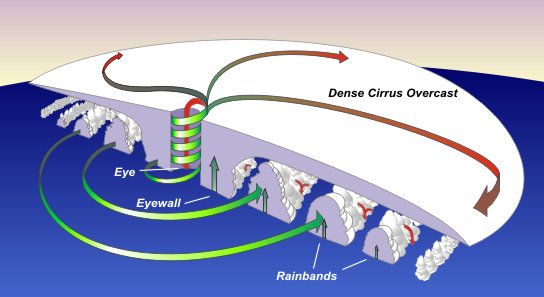
Microteaches #8: Eye Of The Hurricane

This coming week is, for schools, half-term. For those of us brave souls who have decided to work in FE, there is no half-term, only a weird week of no exams, between the AS and A2 period. I've just caught my breath from the AS exams, only to go full-pelt into A2 in just over a week's time. And then it's all over for another year.


Like the eye of the hurricane, this is the oddly calm area sandwiched between two violent storms. So while I can, here are some links and thoughts.

Science

The video "The story of a single heartbeat", available from Understanding Life, should be required viewing for all A-level students looking at the heart.

If that's not enough, then just when they thought they were beginning to understand genetics, they should read this press release on gene modifications. And on the subject of genetics, they should look at Alby's post on Consanguinuity and the coefficient of relationship, which has relevance to much of Edexcel's Unit 2.

There was excitement in the entomology world a few months ago, when giant stick insects, thought to be extinct, were rediscovered on an isolated island. Students of mine who can't cope with the millipedes in the lab may not wish to look at the photos in this link. This is a great example of the role of zoos in captive breeding and reintroduction programmes.

Any students (or teachers for that matter) looking for cell biology images, would be advised to check out The Cell: An Image Library. That said, much of what I teach them at A-level and BTEC is a massive simplification, or a model, of what is actually happening in the cell. For example, mitosis is way more complicated than my A-level students think. And I genuinely had no idea that cells shut down during cell division.

There's a sweet illustrated guide to the evolution of different skin colours, which is a little simplified for A-level, but a nice introduction nevertheless. On our evolution, there's another hypothesis on why we walk upright.

Teaching

It's one of the most stressful times of the year for teachers, and certainly for their students, so it is good to be reminded of the physiology and treatment of stress, by Informed Education.

Putting into perspective my own success and progression rates, it is a timely reminder that, according to this DfE report on progression, in FE colleges, only 55% of AS biology students progress to A2.

For my students who are feeling demotivated, and worried that they are going to be outperformed by independent school students, there is research indicating that state school students actually do better in their university exams. Your time will come, my darlings.

I'll be trying to shake off the image of Cambridge as a toff's playground when I take four of my finest to the Cambridge open day in July. Nothing will make me prouder than being able to show off my students at my alma mater. I've even found my CAM Card...

Finally, I'm reassured by this post on being the "right kind of science role model" by Marie-Claire Shanahan. As a teacher I have a worrying amount of influence on my students. None of them want to be FE biology lecturers any time soon, but occasionally I get a breakthrough. It is a comfort that I am helping by engaging with them, discussing careers and being open about gender differences in the sciences. I'm probably helping more than my (male) physics lecturer colleague who declares that "biology is for women".

Tuesday, 20 March 2012

The Hugging Minefield

A heartbreaking end to the working day today. I was sitting in my lab marking some mock exam papers. One of my students appeared and asked if we could talk. And then this tall, confident young man just broke down in tears. Events of the past few weeks, months, years even, caught up with him. Poor lad is terrified of not getting the grades he needs, and he's got an awful lot of mitigating circumstances affecting his chances of achieving this. I grabbed a handful of paper towels in the absence of tissues, and he clung to them for dear life as we spoke. We went over what it was getting to him in terms of workload, how he was feeling, whether he was anxious or depressed, and what action he felt able to take at this stage.

On balance, he was in a better state when we concluded than he was when he came in. He knows he can come back and talk to me. But above all that, he probably needed a hug. I really felt he did. But I didn't think I could. Why? Well, we have guidelines telling us to avoid unnecessary contact with students. I'm normally quite a touchy-feely person. I do hug and kiss my friends when I see them. A hand on the shoulder, a high-five, a fist bump, all feature in my normal friendly repertoire. But I've toned it right down for dealing with students.

If I am seen giving a student, especially a male student, a hug, then that would certainly start a rumour mill going - some of my colleagues have raised eyebrows at my close working relationships with male students (though it is usually because the male teachers have a tendency to be really hard on the male students, oddly enough), and I can do without a lot of gossip about me. Some of my female students have put an arm round me, and one of my BTEC boys decided he would grab my hand and kiss it directly underneath one of the CCTV cameras (doh!), but reciprocation is definitely frowned upon.

Finally, I am aware that I've got a rather insecure (though adult, he was definitely in a vulnerable emotional state) student pouring out his heart to me; I don't want him to think that our relationship is anything more than teacher/mentor and student. Students can become infatuated with their teachers, and though I don't think I'm much of a TILF, I've overheard students talking about the hotness of the most surprising colleagues. Positions of authority appear to be quite an aphrodisiac *boak*.

It was much more straightforward when my poor husband came into the lab half an hour later and also burst into tears. That I could deal with. Teaching is hard work. He had his awful class today. They stole his favourite pen. There is nothing in the guidelines that says I can't hug my own husband at work, and frankly if he thinks I'm a TILF then that's all good...

How do you lot approach comforting students? I imagine for the under-16s it's a no-brainer - no contact at all. But how do you comfort sixth-formers and adult learners? Is it still such a no-brainer? I wonder if it will be easier for me to dish out hugs when I get older. A colleague in her 50s had no qualms about hugging any and every student, but she was by that point easily old enough to be their mother - I'm still just about young enough to be a cougarish girlfriend.

Thursday, 23 February 2012

Microteaches #7: I Thought Half-Term Was A Holiday?

Half-term was last week. I thought I'd have a bit of a break, some time to lie in. Didn't happen. We had an action-packed few days celebrating my birthday, and there were builders in renovating the flats upstairs, which consisted of drilling and hammering very loudly from 8am. There was a frisson of excitement as they managed to drop a heating pipe through our ceiling on my birthday itself, and that of course was it - it was impossible to relax when wondering if any more hardware was going to pitch itself into our flat. I'm so tired that I feel like Steve.


Pissing me off massively during half-term was the article in the Indy stating "Female teachers accused of giving boys lower marks". The paper itself is available here. Sadly I don't understand enough of the statistical metrics, and indeed didn't have much time to read in detail, to be able to comment much beyond the executive summary. But the basic gist seemed to be that boys assume that their work will be marked lower by female teachers so they don't try as hard. Girls assume their work will be marked higher by male teachers so they try harder. And while female teachers confirm the boys' beliefs by marking girls more leniently, the male teachers mark boys more leniently.

So what is going on there? I don't feel that I do mark boys' work more harshly. I sometimes think I do the exact opposite. Male colleagues of mine are exceptionally hard on the boys, and on many occasions I've had blazing rows with them to try to save my boys' places on courses. If anything I allow boys more leniency than girls to compensate for my colleagues. I am but a single data point though. And to be fair, my style of teaching mostly involves revealing increments of cleavage in return for coursework.


Professional Pob impersonator and all-round fucking moron Michael Gove has delivered another slap in the face to teachers by saying "If you [teachers] love your job then there is, I think, absolutely nothing to complain about in making sure you have more of a chance to do it well" (from Huffington Post). This is in the context of expecting us to stay longer during the day and take shorter holidays.

Well, Govey, this week went as follows. On each morning I've been in at 8am - this is the earliest I am allowed to enter the premises. If I could go in at 7:30am I would. On Monday I left at 6:30pm when the college shut. On Tuesday I left at 8:45pm, yesterday at 7:45pm and this evening I ducked out early at 7pm. Tomorrow is a training day so I might get to leave at 5pm. Twelve-hour days are nothing unusual. On Tuesday and Wednesday I had to sit down at my laptop when I got home and work for another three hours. During half-term most of us went into work on at least one day of our holiday, and I will have three days taken out of my Easter break for revision purposes. So I would like very much to know what more Gove would like me to do.

This term is all about coursework, and my A2s are starting to complain that they're not doing fieldwork. They were the ones who moaned like buggery about having to do so, and now they're having to live with doing lab-based research projects. It's going to be an absolute disaster. The AS students are doing better, and some of the more interesting topics I've seen are on ageing, cirrhosis of the liver, Kawasaki disease, conservation of gorillas, testicular cancer and equine colic. We're going on a trip next week, so if you hear that a constituent college of the University of London out in Surrey has burnt to the ground, you'll know that was my lot. I predict it will be a matter of minutes after the coach pulls out of our car park before the strains of "Stop the bus I want a wee-wee" are heard...

FML.

Thursday, 17 November 2011

NPG WTF

There have been two articles resurfacing (as it turns out) in the press. One of them is an opinion piece by the Chancellor of Buckingham University (link - it's so awful my college has blocked it "because the content contained prohibited words and/or phrases"). It talks about female students being a "perk" for male lecturers and professors. Read the Guardian article on the subject - it isn't blocked for porn.

The other is a short fiction article in that bastion of hyperbolic science Nature. It's entitled "Womanspace" (or there's the PDF). It passed without much comment when it was published - just goes to show no one reads Nature for the short stories. It was only when two responses were published in today's correspondence section that women in science started to prick up their ears.

Anne Jefferson has written a brilliant response: Dear Nature, You got a sexist story, but when you published it, you gave it your stamp of approval and became sexist too. And this is it - Henry Gee (@cromacrox if you're interested...) is the Senior Editor of Nature. He approved the publication of this story. He even had the nerve to gloat afterwards:
I'm amazed we haven't had any outraged comments about this story.
Well you got them now, Henry. And you probably think it's going to drive more and more traffic to you, and that there's no such thing as bad publicity. My husband @panderson1979 has suggested that a campaign to the advertisers might hit Nature where it hurts. There's a whole hashtag, #womanspace, devoted to it already. I imagine the author, @edrybicki, is waking up to some interesting replies this morning.

I commented to a friend on Twitter that so much sexism seems to be as a result of a few men thinking they're being funny. And I imagine Ed Rybicki thinks it was rather funny. And I imagine Henry Gee thought it was also funny and a jolly good wheeze. Henry Gee has prided himself on striving for equality in academia, and especially tackling institutionalised anti-semitism. Yet he approves a discriminatory fiction story because it's discriminatory against a group of which he is not a member. He would not have published a story entitled "Jewspace". One could not get away with writing the sentence, and Henry would not publish it:
"But the answer is clear: Jews can access parallel universes in order to find things, whether they do it consciously or not."
The article would be offensive if "blacks" or "gays" was substituted in for "women". From "Blackspace":
"I said, only half-joking: 'Well, blacks seem to be able to do that - maybe they’re getting into spaces we poor guys can't?'"
And from "Gayspace":
"Gays, on the other hand, gather: such that any mission to buy just bread and milk could turn into an extended foraging expedition that also snares a to-die-for pair of discounted shoes; a useful new mop; three sorts of new cook-in sauces; and possibly a selection of frozen fish."
Just to be clear, these are unacceptably discriminatory sentences. So why would Henry Gee allow these things to be said about women in his journal?

It is hard enough to be a woman in science, and sexism is rife in academia. Sexism and the enabling of sexist behaviour is one of the many reasons I am "just" an FE lecturer, when I could have been a PhD. I fear for my female students' welfare as I send them off to university each September, and hope that their enthusiasm and optimism for their future isn't eroded away too quickly.

Update: As well as Anne's post linked to above, also look at The Biology Files and Science Sushi, who have further thoughts. And for an editor and publisher's take on this, look at my awesome husband Paul's Open Letter to Nature. Paul is fortunate enough to be 50% of one of many couples that proudly show the 1950s stereotype to be utter fiction...

Thursday, 10 November 2011

Things I Learned From My Students #10: Somebody's Watching Me

I haven't done one of these for a while - nearly a year in fact. The two weeks since half-term have been absolutely mad, but that at least means some more ammunition for this.


So here's what I've learned from the little sods recently:
  1. The words "turgid" and "flaccid" are hilarious.
  2. I can still just about pass for someone in their late 20s.
  3. Everything can be expressed as "bare", "sick", "peak", "long" or a combination of any of the previous.
  4. It is a matter of some concern that a woman with my qualifications should be a teacher in an FE college.
  5. We have a child's skull in our anatomy collection.
  6. I can use this fact to extract homework from the younger students.
  7. Students may think they want to be surgeons, but they recoil in horror at a horse dissection and the autopsy scene in "Contagion".
  8. Apparently a 31-year-old, married, female biology teacher needs to be told the location of the G-spot.
  9. If your physiology class contains mostly boys, then at some point each week someone will ask about masturbation.
  10. The question biology teachers are asked most frequently is "What does this rash mean?".
  11. Supposedly mature students returning to study still think it's appropriate to refer to "poo" when writing about the digestive system.
  12. If one student misses the day of the presentation, they can have an extension. If half the class misses the day of the presentation, half the class fails.
  13. It's surprisingly difficult explaining to students how a Placebo Band works.
  14. No one teaches these kids how to draw graphs at KS3 or KS4. As a result there are 18-year-olds drawing graphs in biro without a ruler on 20% of the page.
  15. Time is an illusion. Lunchtime doubly so.

Saturday, 29 October 2011

Museum Shop Items

Yesterday, Paul and I went into London to see the "Private Eye: The First 50 Years" exhibition at the V&A Museum, followed by the "Wildlife Photographer of the Year" and "After Hours" at the Natural History Museum. All were excellent, of course.

However...

Being an advocate of avoiding stereotypes, especially for younger children, I was distinctly unimpressed to see this in the V&A gift shop:


The "Good Things for Girls" pack contains a skipping rope, colouring pencils and a knitting doll. The "Good Things for Boys" pack contains dominoes, juggling balls and a boat. Now, to my mind, there is no reason why boys can't enjoy skipping, colouring and knitting, nor why girls wouldn't appreciate dominoes, juggling or sailing a toy boat. However, they have been neatly packaged into the "traditional" roles.

I do bang on about this, but I have real trouble with an organisation that advocates itself as an academic institution (there are strict eligibility criteria for the use of the .ac.uk domain), which happily sells items that do not promote equality of opportunity for all children.

On a different note, there were no gender issues at the NHM, but there was a nice bit of taxonomy-fail:


Echinoids being confused for trilobites? Crinoids being confused for ferns? I think someone had a long day.

As an aside, we saw the newly-refurbished dinosaur gallery at the NHM. It's still dark, still dingy, still impossible to take a photo of an entire skeleton, still utterly inferior to pretty much every single dinosaur hall I have ever seen at a museum (I'm sure someone made a point about this a few weeks ago but I can't find the blog post to credit them). I don't know what they did in the refurb - there were a couple of new panels, and a bit of new CGI. The science is still mostly good, but bland and uncontroversial enough that it's good for a few more decades I suppose (!). It wouldn't even need so much high-tech stuff - just specimens, clean, well-lit, accurately mounted, with information about them. Or is that not enough of a money-spinner these days?

Wednesday, 5 October 2011

A Retrospective On My Female Teachers

I started writing this before the summer, as a reflection on the end of my part-time PGCE, my probationary period and my second major exams season. I was thinking about some of the women who have taught me and who in doing so have shaped me as a teacher. This is not to diminish the influence of male teachers - on the contrary, my father, my utterly insane A-level chemistry teacher and numerous university lecturers were all incredibly important. But I wanted to showcase the women in whose footsteps I dare to tread. This seems pretty relevant as a contibution to Ada Lovelace Day, this Friday.

My mother
For most people their mother is their first teacher. We were fortunate that my mother was able to be at home for us throughout our childhood - even now, she is the hub of the house, and visiting my father when my mother isn't around (she spent months in hospital this year) is eerie. I probably cannot fathom how much I owe to her, but I recall how she encouraged me to read lots and lots about the human body. She taught me that On Old Olympus' Towering Top A Finn And German Vault And Hop, although we nearly had a full-on screaming match over which part of a vertebra was anterior (when veterinary anatomy and human anatomy collide...).


© Wikimedia Commons (user FocalPoint)

Genetically, I inherit a good hand for drawing, and I attribute the ease with which I draw cells, tissues, organs and systems to her. But perhaps the one aspect of my teaching most influenced by my mother is my use of The Mayhew Look (named for my maternal grandmother, great aunt and great-grandmother). It is the you-had-better-stop-doing-that-right-now look, the I-cannot-believe-you-thought-you-could-get-away-with-that look, the you-are-in-so-much-trouble-right-now look. One of my A2s last year confessed that the only lecturer he was afraid of was me, and the look strikes fear into the current crop. That is all down to my mother and the pedigree of strong women that came before her.

Mrs Pauline Cassin, Norcot Primary School
When I was about six years old I was notoriously slow at getting changed after PE. Sometimes in desperation I would just put my school uniform on over my PE kit. On one occasion, Mrs Cassin reached the end of her tether, and she got so annoyed with me that she threw a shoe at me. She immediately went to apologise to my mother, who said it was quite okay and she would probably have thrown the other at me as well.

Footwear olympics notwithstanding, however, she noticed that I had rather a talent for mathematics, and I was dispatched every Friday morning for a gifted students class. This may have been the best thing to come out of my entire pre-secondary education. Some twelve years later, I wrote a letter to her via the local authority (she had long since retired), and told her that I had got into Cambridge. She was overjoyed. Sadly, I expect 25 years on, she may no longer be alive.

Dr Elizabeth Jones, Nottingham High School
Dr Jones was one of my A-level biology teachers, and she absolutely loved the Aqua song. She also loved to draw a Native American dwelling when discussing adenosine triphosphate. Yes, I do that now. She used different coloured pens on the whiteboard, and red always equalled energy. I do that too. She was passionate about plants and botany, an aspect of biology that utterly bored me at the age of 18. Now I find myself with classes of students all as bored witless of plants as I was, and history repeats itself. I wish I could go back and tell my idiotic teenage self to listen to her and become fascinated by the inner workings of plants and their place in ecology, but I can't, so instead I tell my students that one day they will find themselves in my position now, wishing they could go back to their biology class.


© Wikimedia Commons (user Fabelfroh)

When I left the High School, she wrote in a little notebook I had for such occasions the simple message Myosotis arvensis.

I didn't.

Dr Christina de la Rocha, University of Cambridge
Christina taught us one of our climatology classes - just a few lectures. They were the only ones I got. She was one of the few members of teaching staff, it seemed, who didn't think it was enough for them to turn up and talk at us. She taught - boy did she teach. Her first lecture is seared in my memory and that of many of my classmates - she said everything she needed to say in 35 minutes, having completely overestimated the time she'd need. She seemed utterly mortified, but we were very happy - after all, it had all made sense. Christina was also one of the few lecturers who would spend as long as it took with us on one-to-one tutorials. She gave her absolute all to her students - something I realise I do too (to the detriment of any form of social life).

She dated my undergraduate supervisor for a little while, and I remember him showing off a present she'd given him - a little vial of bioluminescent dinoflagellates, that glowed when the vial was shaken. It's something I still think is incredibly sweet, and a reminder that geeky science-based gifts can also be cute and romantic.

I'm hoping that maybe, in 20 years' time or so, I will see a blog post (or receive a holographic message delivered by a robot on a hoverbike perhaps??) talking about me in even half as glowing terms. I teach because I love it - I love the opportunity to share my enthusiasm and passion for biology, and I want to inspire more and more students to aim high and achieve great things. We do this with no expectation of thanks or reward, but it's still nice to be noticed...

Monday, 1 August 2011

Women In Science... Again

To those who are not interested in promoting the interests of female scientists, I probably sound like a broken record. It was only a few weeks ago that I was bemoaning more gender stereotyping in the press. This time it is research from the fabulous UKRC that suggests women are being put off science by the stereotypes surrounding female scientists.
"UKRC research suggests women scientists are stereotyped either as frumpy, glasses-wearing cartoon geeks or uber-sexy, Bond-film glamour pusses - who shake their hair out of their specs once they have split the atom."
This is taken from the BBC news story, because I can't find the paper on the UKRC's website!

I suppose I'm more towards the "frumpy, glasses-wearing cartoon geek" end of the stereotypical spectrum. Even on shows that show science in a positive light, many of the female scientists are shown as a bit weird and utterly socially inept (exhibit A, Dr Temperance Brennan, "Bones", and exhibit B, Abby Sciuto, "NCIS"), or alternatively processing crime scenes in Armani suits and heels (exhibit B, pretty much any female character from "CSI").

Katherine made a wonderful point at Endless Possibilities v3.0, when she showed the Google image searches for various scientific disciplines. And it was very interesting to see the stereotypes of female chemists. Incidentally, the stereotypical female biologist is still in the lab coat and gloves, with test tubes and pipettes instead of conical flasks!

It seems what is needed is a concerted effort to show all manner of female scientists (and yes, I would also like to see more profiles of younger non-white male scientists who have control over their hair and who are not megalomaniacs), and to provide opportunities for young prospective scientists to interact with them. If nothing else, The Rubber-Lipped TwatTM's Dream School showed us that students respond best in a one-to-one situation with someone they find inspiring.


What this video doesn't show is what went on once the blonde girl, Danielle, was the only one left, and she had the opportunity to talk to Jane Poynter about science and research (although her profile is a little disheartening). I'm not a scientist - I just play one at conferences from time to time. For some young women, though, I am the only scientifically-minded female they know, and I'm probably not considered a great role model or mentor. I've lost track of the number of times students have said "But miss, you're really clever - you could have been a doctor. Why are you a teacher?" - suppose that shows what they think of my career choice!

Then again, perhaps specific role models can be unhelpful. After all, women do themselves no favours by attempting to morph themselves into the female scientist they admire most. Biochem Belle put it well when concluding the Scientiae Carnival on inspiring women in STEM:
The goal isn’t to become those who inspire us. It’s to find a spark of motivation, an element of respect, and - most of all - the knowledge that through all our exploits, we’re not alone.
Zombie Marie Curie puts it another way:


True.

Monday, 18 July 2011

Microteaches #4: Already Bored

I've been off for ten days now, and the weather has rewarded my year's hard work with rain - all my grand plans for reading in the garden, going out on day trips and doing a lot of catching rays are on hold until Britain remembers that it's fucking summer and is supposed to be warm. The weather picked up nicely on Friday, when I picked up Chris from Highly Allochthonous from the airport and took him for beer and sausages - I think we went through a full reminiscence of every lecturer we'd had in Cambridge Earth Sciences.

There's a new site called Instagrok, which markets itself as a search engine for educational materials. I'm quite taken by the idea of having the more commercial sites discounted from my searches, so I'll be trying it out over the holiday.

Clearing some of my starred feed items, my husband shared this little gem courtesy of The Onion:


I like the satires about fundamentalism and creationism that involve the other students objecting. Sometimes it feels like it's only the teachers complaining about anti-evolution sentiments in the biology classroom, but it's worth remembering that there are a lot of students who want to learn the science, as Doonesbury demonstrates:


On the subject of inspiring students overcoming the odds to study, the Mary Sue ran a feature on Sada Mire, the only active Somali archaeologist in the world. One of my Somali students is really keen on anthropology, and somehow I have got to get her to meet Dr Mire as soon as possible.

I'm on a bit of a women-in-science binge, to prepare for my additional role next year as the chair of our Women In Science committee, and may well have more to say about this, but I noted this press release reported on Labspaces. We have a long way to go, ladies!

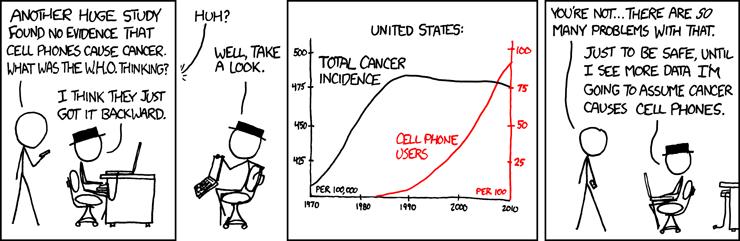
I'll be using this XKCD cartoon in my classes when we have to look at correlation and causation:


And I'll finish off with something that will make the former students who read my blog snigger like they're still at school (bonus points guys if you download and read the paper!): "Immune Activation Reduces Sperm Quality in the Great Tit". Don't say I don't give you interesting articles to read!

Saturday, 9 July 2011

Yet More Gender Stereotyping

Nothing like a good old dose of rage on a Saturday morning to drag me out of my melancholy. Friend of mine Wendy posted this to Facebook first thing, along with a comment that it was "one of the most offensive articles I have ever read". She's written to the BBC to complain, and I will be following suit. The article is entitled "Sugar and spice and all things nice", and I have highlighted one of the more troubling aspects for me and my fellow palaeontologists:


If you can't see it too well, it says "So what's it like to swap muddy football boots and dinosaurs for all things pink[...]?".

For starters it is quite a non-story in any case (seriously BBC - aren't there more important things happening at the moment that could benefit from more attention?). But what is all this about swapping dinosaurs for "pink things"? Are girls not allowed to like mud, or sport, or dinosaurs? Holy shit. I have already informed pinkstinks, as I imagine they'll have one or two things to say on the matter.


The gender stereotyping begins, of course, as soon as babies are born. I was annoyed to see the above juxtaposition at my local garden centre, and when my cousin gave birth to a boy, I scoured three card shops for a congratulations card that wasn't blue, before giving in to the stereotype. My mother sympathised, and in fact my parents did an exceptional job of avoiding stereotypes. They never defined my role or told me what I should be, except, of course, anything I wanted to be. This was how I was dressed (and later dressed myself) for most of my childhood:


I was given as gender-neutral a childhood as possible - I was allowed dolls, teddy bears, tea party sets, and also trucks, dinosaurs and building blocks. As was my brother. My parents are still inordinately proud of the fact that I broke a Tonka truck - they were supposed to be indestructible. My dad would later take me in to school with him during holidays and at weekends, and we'd play on the computers (BBC Micro FTW!), light the Bunsen burners and poke at the skeleton. There was never any question about whether science was something girls did. Science was something I did.

I'm painfully aware that there are gender stereotypes about and within science. Within our department, female students underperform relative to the male students, by a significant margin. I have been tasked with forming a committee to promote female achievement within our subject area. Very few girls take physics AS, and none of them carry it on to A2 at the moment. Biology and chemistry are fairly even. The girls are picking up "soft" subjects, such as psychology and sociology (not my definition - the universities'!). This may be affecting their chances of good university places. In an ideal world we'd like the universities to stop being so up themselves, but it won't happen, and I do concede that really a prospective medical or veterinary student should be doing four full A-levels in biology, chemistry, maths and physics.

It may be a bit of a leap to say that saying pink is for girls and blue is for boys is responsible for female underachievement at advanced level in science, but it is surely a contributing factor. Denying girls access to some of the easiest means of hooking them into science because it's masculine and for boys only tells them that science is for boys. Anyone who was involved with this week's #SciTeachJC has discussed the gender imbalance to some extent, and the paper we looked at does highlight gender differences in the perception of science as a career.

Nevertheless, I have a bit of a monumental task ahead of me, and it really isn't being helped at all by throwaway sexist comments like the BBC have made.

PS: Added in the paragraph above about #SciTeachJC because it is a) relevant and b) awesome.

Wednesday, 6 July 2011

Just A Little Sorrowed Talk

The day I left school to sit my GCSE exams, I remember the last song I heard on the radio before leaving the house. It was "Ordinary World" by Duran Duran, which had come out three years earlier, and I remembered these lines above anything else:

Here beside the news of holy war and holy need
Ours is just a little sorrowed talk

My grandmother shut me up when I whined in a pithier manner: "Worse things happen at sea", which is a really good way of putting a girl off cruises for life. And there are some monumentally appalling things happening in the world, things that I cannot even bear to watch on the evening news anymore. I teach students who have been through so much: refugees and asylum seekers, torture victims with PTSD, whose life stories have made me weep. I get it. And yet, awful things still happen to the rest of us, which is something that Richard Dawkins doesn't seem to get.

For women all over the world, life is lived with a little hint of fear. This is summed up nicely in a post from a couple of years ago, entitled "Schrödinger's Rapist" - in summary: men, until we open the box, you exist in two states - someone who will rape us and someone who will not rape us. The vast majority of you are, thankfully, the latter, and you are wonderful. We don't particularly want to open the box and find out you're the former. Certainly not on a deserted tube carriage, or working late at night at the office, or in an elevator on our way to our hotel room. The odds of you being "someone who will rape us" become much greater in our minds if you do not take no for an answer.

For those of you late to all this, and wondering why I'm rabbiting on, read the "Open letter to Professor Dawkins from victims of sexual assault", posted at Almost Diamonds. Because looking at the "relative awfulness", so to speak, of an uncomfortable come-on in an elevator versus female genital mutilation is flawed at best, downright insulting to victims everywhere.

I signed the letter. This is why. I don't feel as able to write eloquently about it all anymore, so it's just as well all the gory details are permanently online. I spoke about it to a couple of students who had been through a similar experience, and who wanted support and reassurance - it was comfort to know someone else who "got it", but my heart aches for those girls, and all the others whose stories I've read in the comment list at Almost Diamonds.

I wish we didn't have these scars.

Friday, 13 August 2010

Seeing Pink

I don't have a problem with the colour pink as such. On tropical flowers it is fiery and exciting. On my gardening tools it is a necessary high contrast colour where I might drop a glove or secateurs on the soil or foliage. Shocking fuchsia pink is a colour that suits me and my skin colouring. My "Pink Pen of Mild Peril" has been more popular among male and female students alike than its predecessor the "Red Pen of Doom". It's a nice colour.


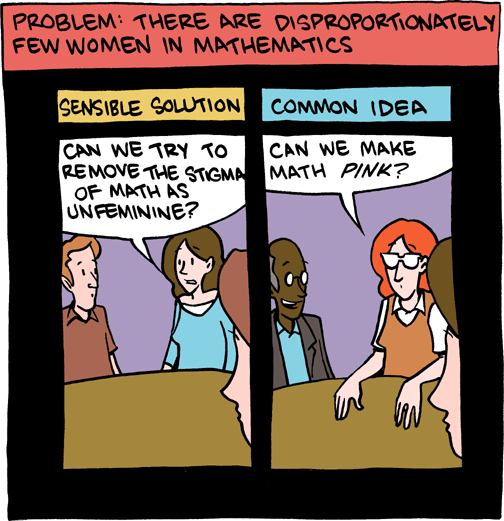
But, as this comic from Saturday Morning Breakfast Cereal shows, the colour pink is being used as a lazy shortcut to getting girls and women interested in science, technology, engineering and mathematics (STEM). It isn't a new phenomenon by any means. There is a superb campaign called Pink Stinks, that "challenges the culture of pink which invades every aspect of girls' lives". it highlights many awful examples of this invasion on its blog. As of Saturday morning, I have a further addition to their collection of pink crap.


Ahhh, folks, remember the good old days where anti-intellectual teasing and bullying was unisex, and one could only buy black-framed "nerd specs"? If that wasn't patronising enough, then you can do a quiz on the back of the pack to see whether you truly are a "geek girl".


Particular gems include:
  • Did you have your first drink on your 21st birthday? - Oh that's good, let's have peer pressure straight off!
  • Have you ever dressed up as Slave Leia? - Not entirely sure that the set of women who have dressed up as Slave Leia and the set of women who may identify or be identified as a geek are identical...
  • Do you have an Etsy account? Have you ever knit [sic] something for a friend? - So if you're creative you must be a geek?
  • Does your skin burn rather than tan? - Aha! So only pale Northern Europeans can be geeks...
I just really, really wish this wasn't an issue anymore. But as long as we have pink, substandard items marketed just to girls, and baby boys killed for "acting like girls", this is never going to go away.

Friday, 15 January 2010

The Word "Penis"

Today I had to teach one of my classes about sexual characteristics. It involved mentioning the word "penis". This turned out to be a huge problem. See, apparently the word "penis" is embarrassing, and represents a filthy and depraved organ of the body. Previously rather brazen young men and women were reduced to giggling children, one of which was so appalled by the mention of the word "penis" that she covered her face with her hands. I found myself conjuring the spirit of my mother-in-law (a primary school teacher) and joyfully trilling to the class: "Penis is not a dirty word!!"

Doesn't help matters that when I try to search for good, copyright-free images to use to teach students reproductive anatomy, all the useful sites are blocked by Websense at work for being pornographic, e.g.:


Can't access that at work. I wonder if that means I'm not allowed to draw the diagram freehand on the whiteboard for the students either?

This strange double standard that we have though: these teenagers are probably more worldly and more exposed to sex and sexuality than ever before, and yet they cannot cope with a simple anatomical word. Some of them are old enough to marry, vote, buy alcohol and be killed in Afghanistan, but the word "penis" renders them incapacitated with the giggles for several minutes at a time.

My local GP practice has a nurse, who refers to a urine sample as "a tinkle" and a cervical smear test as "rude stuff". I think my greatest fear for my students is that, despite my efforts, they will become at best coy medical professionals who embarrass their patients with playground terminology (like my nurse), and at worse rather uninformed adults whose own shame could lead to ignorance (and probably far too many babies for them to cope with).

Suppose the religious right would blame it all on snakes, women and apples, but I wish we could all get over the idea that penises and vaginas are something dirty that must never be discussed even within the confines of a biology lab.

What do you think? Am I finally turning into my too-much-information high school biology teacher, who advocated eating placentas and carried around a stick of celery in her labcoat pocket?

Wednesday, 5 August 2009

Exposure To Science In Magazines

Just under two weeks ago, I posted about a quiz testing the science knowledge of the average American, with results broken down by demographic. I noted that the only questions where women scored more highly than men were the life/health science stories, and we got a nice bit of discussion going as to why this might be. KJHaxton hit the nail on the head:
I wonder if it is to do with they types of media each gender is exposed to - women's magazines may be more likely to carry health information, programs (esp in the US) pitched at men focus on more physical things.
So I was tickled to see an example of this in action today.


Fellow palaeo-blogger and far-too-occasional drinking buddy Dave Hone is having a busy week, partly caused by this article. I've only just asked Dave for a PDF (and he might not even have a copy himself yet!), but here's the gist. Adult dinosaur bones are not commonly found with predator tooth marks, nor are adult bone fragments found in the stomach contents of predatory dinosaurs. Add in a distinct lack of juveniles preserved in the fossil record (along with the caveat that a fair bit of this may be attributed to taphonomic bias) and observations of extant predators tending to go for juvenile prey as an easier target than a sick or elderly adult and certainly easier than a healthy adult, and one can hypothesise that adult theropods were preying on predominantly juveniles.

Dave's got a comprehensive post on the paper on his blog, and he says himself it's almost as long as the paper, so I recommend going over and having a good read. But this is the bit that tickled me: it got picked up by GQ Magazine!

I don't know how many countries GQ has reached, but (originally short for Gentlemen's Quarterly) it is at the higher end of the spectrum of men's glossy magazines. It has the articles that all you boys say you read Playboy for. It has fairly intellectual (for a glossy) journalism, and a low tits quotient. The article itself is pretty good - there is no mention of the word "boffin", they've spelled "palaeontologist" correctly, remembered to capitalise the genus name of the dinosaurs concerned, and pretty much explained the journal article for non-scientists. This may be the very first time the word Lethaia has featured on any men's magazine website, but let's hope it's not the last.

Here's the kicker though - there is no way, if I go to the Marie Claire, Cosmopolitan or Glamour websites, that I would see this article or anything like it. I searched for the word "dinosaur" on each website, and all I got was a designer's fashion show where he/she had been "inspired" by One Million Years BC.

*facepalm*

It really does seem as though women are only allowed to be interested in science that directly affects them as wives and mothers and consumers of expensive cosmetics. It's okay to inform men about cool science that (sorry Dave) won't have any impact on their daily lives, because men like cool stuff. Maybe dinosaurs would make it into the women's glossies if they were suddenly found to have been bright pink.

Your thoughts, oh loyal readership?

Saturday, 25 July 2009

Interesting Science Quiz Results

David Bradley of Sciencebase tweeted a quiz on science in the news and asked his followers if we know more science than the average American:

Test Your News IQ

It would appear that I do know more science than the average American (and, I suspect, the average Brit) as I got 12/12. Now, you'll have to do the quiz to see the demographic results, but I thought this was interesting:


I apologise for the lack of labelling - the number column on the far right indicates the percentage of female respondees who answered correctly for each question. The number column immediately to the left indicates the percentage of male respondees. On nine of the questions, men scored more highly than women, but on three questions women did better than men:
  • Which over-the-counter drug do doctors recommend that people take to help prevent heart attacks?
  • How are stem cells different from other cells?
  • True or false: Antibiotics will kill viruses as well as bacteria.
These are the three biology/medicine/life science type questions - the other being geology/chemistry/physics/astronomy based. Now, I can't obviously say whether this is statistically significant, although maybe the Pew Research Center will follow up on this. However, when I was at university, physics classes were made up mainly of men and biology classes were made up mainly of women - even at the University Of Cambridge. Gender stereotypes manifesting themselves even among adults? Biology is "nice" and "soft" and you can go along and work with flowers and cute fuzzy animals, young lady, but leave the "serious" physics and astronomy to the more mathematically-minded men. They will solve our real problems. Is this a case that women are more educated in life sciences and less so in physical sciences than the men? Or, being in the vast majority the primary care-givers, do they simply pay attention mainly to the science news that directly affects the health of their family and ignore the rest (remember that awful exchange on The View about whether the Earth was flat)? Conversely is this support for the commonly-held view that men tend to ignore their health? Do they ignore it because they're uninformed or are they uninformed because they've ignored it? So, what do you think? I've used sweeping generalisations here with only that number table to back up my thoughts, but I wonder if there is a real signal there and what the reason might be.
Related Posts Plugin for WordPress, Blogger...