Friday, 13 August 2010

Seeing Pink

I don't have a problem with the colour pink as such. On tropical flowers it is fiery and exciting. On my gardening tools it is a necessary high contrast colour where I might drop a glove or secateurs on the soil or foliage. Shocking fuchsia pink is a colour that suits me and my skin colouring. My "Pink Pen of Mild Peril" has been more popular among male and female students alike than its predecessor the "Red Pen of Doom". It's a nice colour.
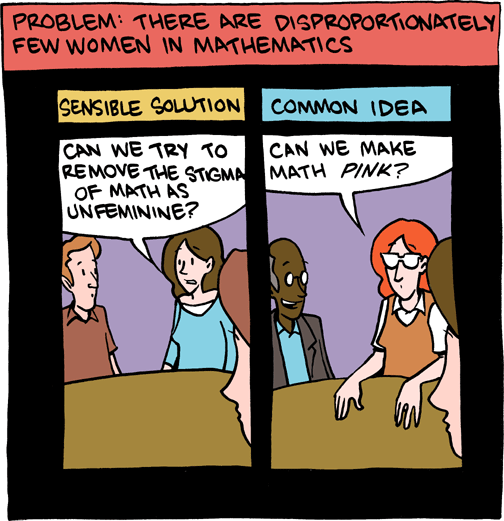


But, as this comic from Saturday Morning Breakfast Cereal shows, the colour pink is being used as a lazy shortcut to getting girls and women interested in science, technology, engineering and mathematics (STEM). It isn't a new phenomenon by any means. There is a superb campaign called Pink Stinks, that "challenges the culture of pink which invades every aspect of girls' lives". it highlights many awful examples of this invasion on its blog. As of Saturday morning, I have a further addition to their collection of pink crap.


Ahhh, folks, remember the good old days where anti-intellectual teasing and bullying was unisex, and one could only buy black-framed "nerd specs"? If that wasn't patronising enough, then you can do a quiz on the back of the pack to see whether you truly are a "geek girl".


Particular gems include:
  • Did you have your first drink on your 21st birthday? - Oh that's good, let's have peer pressure straight off!
  • Have you ever dressed up as Slave Leia? - Not entirely sure that the set of women who have dressed up as Slave Leia and the set of women who may identify or be identified as a geek are identical...
  • Do you have an Etsy account? Have you ever knit [sic] something for a friend? - So if you're creative you must be a geek?
  • Does your skin burn rather than tan? - Aha! So only pale Northern Europeans can be geeks...
I just really, really wish this wasn't an issue anymore. But as long as we have pink, substandard items marketed just to girls, and baby boys killed for "acting like girls", this is never going to go away.

Saturday, 7 August 2010

Problems At Grand Teton

Of all the places my husband and I visited on our honeymoon, Grand Teton National Park was a particular highlight. Much less crowded than its northern neighbour, Yellowstone, it is an underappreciated gem in the state of Wyoming, with truly astounding geology, landscapes, flora and fauna.


Grand Teton has had a troubled journey towards its eventual designation as a National Park (with its present boundaries) in 1950. In the Creation of Grand Teton National Park PDF, it is cited as "perhaps the most notable conservation victory of the twentieth century", and for me at least few places can match it in terms of sheer beauty.

So it was with some horror that I read this article: US National Park Faces Sale. Now, the vagaries of US land ownership are bewildering to the average Brit, but according to the Grauniad and another article from NPR, there are some parts of the Park that are state- rather than federally-owned, known as "school trust lands". Two of these pockets of land, up to 550 hectares, may be sold to generate revenue, according to Governor Dave Freudenthal, if the federal government don't make a deal.

School trust lands are meant to provide income for state education, and while the land could be worth $125 million, Wyoming only receives $3,000 a year from leasing it to a rancher. Selling the land would provide much-needed funds for a state that could obviously do with some extra cash for education.

In an ideal world, the federal government would buy these odd parcels of land in the middle of the rest of their National Park for near enough the market value. A trade in land hasn't been accepted. This is a wrangle that has been going on for a decade - throughout George W. Bush's entire term and into Barack Obama's. Sadly, I'm not convinced that Dubya left a lot of small change to counter that massive federal deficit, so Obama may not be able to do anything about it.

Which means that the state of Wyoming may sell the land to private developers. The land in question is sagebrush steppe and grazing land, seen in the foreground of my favourite photo:


While I'm aware that Wyoming desperately needs money, and I would certainly rather see the money go towards education than fuel exploration, defence or bailing out corrupt banks, I feel incredibly sad that the Governor is prepared to sell land in the middle of one of the most beautiful national parks in the entire USA.

Of course, I welcome comments, especially if there are any errors or better explanations for what I've written.

Update 23:57, 07/08/10: According to an earlier, evidently unnoticed, interview with Stateline, Governor Freudenthal says:
"No, no. We're not short of revenue. We're in pretty good shape. Our revenues are ahead of projections. We're sitting on about $800 million in cash reserves and we expect the next projections to show revenue probably $200 million to $300 million over projections. So this thing about the Grand Teton is not driven by that."
So clearly the entire state of Wyoming is doing just fine and dandy. Which rather changes things, don't you think?

Friday, 6 August 2010

Organising Fieldwork

I have 10 days before I return to work full-time after the holiday, and I am starting to look forward to the first term and what I can plan for the students. I'm also getting all these out-of-office e-mails from contacts, saying they're off in the middle of nowhere playing with fossils, so I'm feeling envious. In any case, fieldwork is on my mind.

As it stands, I have the A2 biology students, one of the AS biology groups, the second-year applied science class, the first-year forensic science class and the first diploma applied science group. The A2s and second-years are going to get fieldwork...

This year we had a very successful three days at Perivale Wood. Being an ancient oak woodland with some conservation and clearing, there are a lot of opportunities for original fieldwork.


If you're Russell Crowe, you should note that the above is what an oak woodland looks like, as you never had the opportunity to act in one. </snark>

We did the fieldwork in late February of this year. It was a good time in that there were lots of bluebells coming up, so density surveys could be carried out of those species. However, it was difficult for the students to identify the different deciduous trees, and any animals were still in hibernation. Waiting until later in the year is not really an option, as the examining board requires that all coursework is submitted by May, so for the A2 students, it looks like we're going this term.

So we can do some animal diversity surveys of the various ponds (and the student who complains the most about being outside will be given the waders and dispatched to the centre of the pond). I think some enterprising students with GPS on their phones can probably do things like measuring circumference of the trees (as a proxy for age) in relation to distance from the railway embankment or the canal, or similar. And we can do the usual number of plants/number of species against light intensity/pH/moisture levels.

The applied science students, however, will get to go in April or May, as their coursework isn't due in until June. They'll be studying plant and soil sciences, so they at least will be relieved that they don't have to go in the pond.

They will, however, have to deal with what this year's A2s considered the most horrific aspect of fieldwork:


Any tips on how to get teenagers comfortable with the idea of going for a pee outside? It would appear that my "Shut up and get on with it" attitude is not overly well received.

Wednesday, 4 August 2010

Triceratops And Tribulations

ResearchBlogging.org
Do a Google News search for Triceratops and you'll be faced with some worrying headlines. Screeching at you from the screen are "Triceratops never actually existed, scientists say", "Scientists: Triceratops May Not Have Existed‎", "Triceratops' status as a distinct species threatened" (note that I've italicised the genus name, because FSM knows that subtlety is lost on the majority of journalists). I'm wondering if the Daily Fail will be decrying this as Political Correctness Gone Mad, shrilly complaining about the further destruction of our childhoods...


Of course, as numerous bloggers have already commented, this is all bollocks. Nothing is happening to Triceratops.

The paper that has kicked it all off is this: "Torosaurus Marsh, 1891, is Triceratops Marsh, 1889 (Ceratopsidae: Chasmosaurinae): synonymy through ontogeny", by John Scannella and John Horner (find it here). Before you even look at the paper itself, there are a couple of clues in the title, and you don't need a PhD in palaeontology to pick up on these clues.

The first is that the authors say "Torosaurus is Triceratops". While that could be open to some linquistic interpretation (perhaps more so for non-native English speakers), it is pretty clear (I checked with the Token Non-Scientific Adult, aka Paul) that this means Triceratops is the one that gets to stay.

The second is that Tricertatops was named first. In most fields, it's the first named/discovered/invented item that gets to take priority, and genus and species names are no exception. Naming animals is governed by the International Code of Zoological Nomenclature (ICZN), and if you're feeling a bit nerdy you can look up Article 23.1:
Statement of the Principle of Priority. The valid name of a taxon is the oldest available name applied to it, unless that name has been invalidated or another name is given precedence by any provision of the Code or by any ruling of the Commission.
So the taxon made up of all Triceratops specimens and all Torosaurus specimens is validly known as Triceratops, the oldest available name applied to it. It is this rule that means Brontosaurus is actually Apatosaurus, although in marginally different circumstances.


So what did Scannella and Horner actually do? They measured their specimens using ontogenetic markers - the development of the parietal fenestrae and the elongation of the squamosals. They also looked at osteohistological features, and found a sequence from Triceratops specimens with primary, spongy bone structure to Torosaurus specimens with secondary, compact bone structure. They conclude that this is a growth sequence, and looking at the photos in the paper I see no reason to doubt this.

As for squamosal elongation, they have a fascinating graph of squamosal length/width against squamosal length (and I hope they don't mind me showing this):


Significant overlap between Triceratops specimens and Torosaurus specimens (I presume the categories of "baby", "juvenile", "subadult" and "young adult" are obtained from osteohistology samples - must read this more fully...). I'd have loved to see some of these analysed using geometric morphometrics - in such analyses elongation is most commonly the largest component of variation, but if you start looking at the smaller components you can get some really interesting results.

This paper highlights a problem that Peter Dodson discussed 35 years ago - that there is a real problem with juveniles and adults being incorrectly classified as different species or genera. Cheneosaurus and Procheneosaurus are juvenile lambeosaurines (which is all reminding me to write up my geometric morphometric Ornithopoda paper...), for example. While, with the benefit of more specimens, better understanding of osteology, microscopic techniques and improved communication within the field, palaeontologists may not be splitting juveniles and adults now, there are undoubtedly question marks raised over some of the rapidly-described skeletons from the Cope-Marsh "Bone Wars" era, of which Brontosaurus-Apatosaurus and Torosaurus-Triceratops are two examples.

I imagine my students will have picked up on this over the summer holidays, so we'll be able to use it as a springboard to talking about classification, taxonomy and the all-important "How Science Works" aspect of the curriculum. Time for me to start practising drawing Triceratops and Torosaurus skulls freehand on an interactive whiteboard!

Scannella, J., & Horner, J. (2010). Torosaurus Marsh, 1891, is Triceratops Marsh, 1889 (Ceratopsidae: Chasmosaurinae): synonymy through ontogeny Journal of Vertebrate Paleontology, 30 (4), 1157-1168 DOI: 10.1080/02724634.2010.483632
Dodson, P. (1975). Taxonomic Implications of Relative Growth in Lambeosaurine Hadrosaurs Systematic Zoology, 24 (1) DOI: 10.2307/2412696

Tuesday, 3 August 2010

Another Kick In The Teeth For Micropalaeontologists

Back in June I wrote about the plans to close the Micropalaeontology Division at the Natural History Museum. Looks like there'll be more cuts in that field.

The New York Times has the article: "Gulf Drilling Boom Goes Bust For Key Group Of Scientists". Two companies, Paleo Data and BugWare Inc., look set to fold.

The environmentalist in me doesn't want any more oil wells to be drilled, and I could weep at the destruction the Deepwater Horizon disaster has wrought. But I cannot decry the closure of an academic institution while letting the problems in the industrial branch of the profession go by unacknowledged.

Sad times.

Monday, 2 August 2010

Making Evolution Visible

There has been a flurry of discussion over the news that the creationist Noah's Ark Zoo Farm has been awarded a "Learning Outside the Classroom" quality badge. The TES has a summary of the issues, and quotes:
It has attracted controversy for its views on evolution and creation, arguing that science has tried to "remove any notion of God from our understanding of life".

"This is unjustified and we look to put the case for a Creator across to those who wish to investigate," the zoo's website says.
At least, according to one commenter, Noah's Ark is "a really boring place to go to compared to the excellent Bristol Zoo only 20 minutes away", which should be a deterrent to any teacher looking for a good all-round animal experience for their students.

So it's refreshing to see that there are attractions making evolution part of their own stories. Today, Paul and I visited Birdworld, about an hour's drive away. The birds are marvellous, and pretty tame - Paul handfed an avocet.


There's a mural of extinct giant birds, including Dinornis, Aepyornis and Diatryma, seen with Paul (looking extremely dashing) for scale. And a display on the evolution of birds:


I'd have liked to see "There's a dinosaur in your garden!" rather than "Is there a dinosaur in your garden?", but it's great to see a cast of Archaeopteryx on display. The captions read:
  1. One theory is that some dinosaurs first developed feathers (called proto-feathers) for warmth. These dinosaurs were small, light and fast like birds.
  2. Over time proto-feathers became longer to help with balance when running. Muscles in the forelimbs grew stronger with increased use. Together, the use of proto-feathers whilst running and leaping slowly lead [sic] to flight.
  3. In modern birds the large breastbone acts as an anchor for powerful flight muscles. The wishbone helps brace the chest during flight. They have replaced heavy teeth with a lightweight beak.
It's not perfect - it's more narrative than I'm happy with, and there's a bit of a suggestion of Lamarckism, but there is a nice big section saying "Birds have continued to evolve for improved flight since Archaeopteryx".

It's low-tech - it's a (beautifully) painted board with laminated printout labels. The biggest expense was probably the cast of Archaeopteryx and the model Aepyornis egg. But it doesn't need to be son et lumière with computers and holograms. This works, and it would be great if more wildlife attractions could find it in them to put a bit of evolution back into their displays.

Friday, 30 July 2010

References And Resources

A very interesting discussion is going on via the Dinosaur Mailing List (it's also on the Vert Paleo Mailing List, but there isn't a nice linkable archive for that one). How to cite information in Wikipedia? As such threads are wont to do, it has become more a discussion of whether Wikipedia is reliable, and whether it should be allowed by lecturers and teachers in students' work.


I teach three main groups of students: A-Level, GCSE and BTEC. I expect my GCSE students to be able to use information from my lecture notes, their textbook and any extra handouts I give them. For A-Level students, with the exception of their coursework, that's pretty much the same situation, although I like them to use a range of textbooks if they can. The biggest issues I have are with the BTEC students, on a 100% coursework programme, and when I'm doing coursework with the A-Level kids.

Wikipedia is sometimes an absolute blessing for teaching. I have found high-resolution images of hazard symbols, beautiful human anatomy diagrams, and superb chemical formula PNG files, which fit very nicely into my lecture notes. Used correctly, it is an excellent first port of call, and the key is to look for the sources cited on the Wikipedia page in question, before directing one's attention there.


To this end, for A2 coursework, where the students carried out independent fieldwork, they were banned from citing a Wikipedia source. AS and A2 students are required by the syllabus to evaluate their sources, and so an opportunity presents itself very early on to discuss some of the pitfalls of using Wikipedia. I recall seeing an article some time ago stating that the Spartans won the Battle of Thermopylae due to their use of superior laser weapons[*].

However, I have not, up to this point, made such a restriction on my BTEC students. Perhaps this is because, in general, the A-Level students have grasped the idea of Harvard referencing and reliability of sources more quickly (had it not been for safeguarding, I could have hugged the few BTEC students who, by the end of their first year, had managed to correctly cite a textbook). In reality, I suspect it's been down to laziness on my part. I have to mark one 3000-word paper from each A-Level student each year. I have had to look at, on average, 25 pieces of work from each BTEC student, and I've had double the number of students on the BTEC course. It takes energy to remind students each and every time that Wikipedia is not an unquestionably accurate source.

This is no excuse, of course. And to this end, I am contemplating placing a restriction on my BTEC second year students for this year. I think, however, that I will allow them to use material on Wikimedia Commons, as much of this is original material not available elsewhere.

As for how to cite things, I have found Neil's Toolbox to be a great website for helping students make their Harvard references. I put it in all my Moodle course pages, and spend time with all the students checking that they have the hang of the system. My A2 and BTEC students have all cited primary literature too, which is quite an achievement at this stage. I can't say I'd have known the first thing about primary literature when I was doing A-Levels, let alone be able to cite it.

[*]If you don't know why this is so utterly wrong, then there is no hope...

Monday, 26 July 2010

Summer Reading

Unencumbered by PhD study anymore (or more realistically, guilt about not doing any PhD study), I find myself able to relax and indulge my love of reading again - something I haven't managed to do in quite some time. So here's what I'm intending to get through before 16th August...

"Silent Spring" by Rachel Carson
I've been reading this on and off for some time. I read most of it back in April, while I was being tattooed (leading one of the other tattooists to say he had never seen anyone so laid back as me). I have the final few chapters to finish, and I'll do that as soon as I figure out where my husband has "dobbied" the book.

"The Origin Of Species" by Charles Darwin
It is my dirty little scientific secret, that I have never actually read Origin. I have started reading it many times, but to be honest it's not an enthralling read to begin with, and it's quite heavy going. Without the distractions of trying to read it on a commute, however, and being able to curl up on my sofa or in a sun lounger in the garden, it's far more manageable.

"Chocky" by John Wyndham
Having already devoured the newly-discovered "Plan For Chaos", I'm on another Wyndham roll. I very much enjoyed "Plan For Chaos", although the unusual decision of Wyndham to have an American lead grated a little.


"The Greatest Show On Earth" by Richard Dawkins
Always looking for more easily explained and more obvious examples of evolution for my students, a fellow lecturer at college recommended this to me. It's nice to have a colleague who is as rabidly pro-evolution as I am, as there are surprisingly few of us on the staff, even in science (worryingly).

"The Victorian Fern Craze" by Sarah Whittingham
Being something of a pteridophile, I love the idea of having lots and lots of ferns around. One day, when I win the lottery, I will have a cool fernery, a warm fernery and plenty of stumperies around my extensive grounds. Until then, I have a courtyard, a window seat and some aspirations.

"The History Of Science" by Sean Johnston
I studied "History and Philosophy of Science" for a year at Cambridge, and they were some of the most interesting and entertaining classes I ever took (e.g. "Ever notice how the greatest people were always known just by their first names? Galileo, Leonardo, Tycho, Madonna..."). I'd like a refresher, partly for my own interest, and partly to be able to answer more of my students' questions and help them understand the historical significance of theories and discoveries. As I'll be teaching a class on "Perceptions of science" this coming term, it'll help broaden my expertise.

"The Origins Of The British" by Stephen Oppenheimer
It's a big book, but all it'll take will be a few rainy days. I am constantly astounded at British and American right-wingers who complain about immigrants and what a "true" Briton or "true" American is. I eagerly await the day that BNP leader Nick Griffin, wonky-eyed hatemonger-general, is found to be 1/64 Pakistani, so that I can watch him try to vomit up all his internal organs.


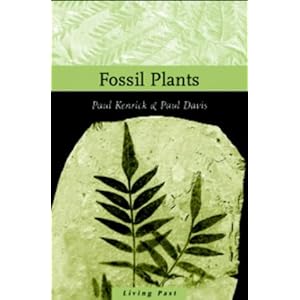
"Fossil Plants" by Paul Davis and Paul Kenrick
You can take the girl out of academia, but you can't take the academia out of the girl (that phrase sounds better when it's talking about honky-tonks). So this will keep the old brain cells ticking over a bit, and get my l33t plant taxonomy skillz up to the same high standard as my animal knowledge. I am determined that my final-year students will leave with a new-found appreciation of the plant kingdom, and I hope to do that with more than just a Mimosa pudica (although they are cool).

So that's what I plan to do with myself until the end of the holiday. We're not able to get away anywhere, but I am absolutely knackered. I'd be interested to see what you lot are reading (those of you not lucky enough to be in the field anyway).

Sunday, 25 July 2010

Using The Geoblogosphere In Teaching

Since I'm on a bit of a roll here with the blogging, I'm going for this month's Accretionary Wedge carnival, hosted by the History of Geology blog. It's nice to still feel part of the geoblogosphere - Chris has added Stages Of Succession to the "allgeo" feed, and I'm finding my new niche in the discussion of evolutionary science education and good old scientific literacy.

Over my year of teaching, I have noticed something odd about my students (actually, there are a lot of odd things about my students, but those are other blog posts entirely). They use the internet way more than I do - I receive e-mails from them frequently, and I have lost track of how many times I have to boot the little darlings off Facebook during class time. They have iPhones and Blackberries (one girl has three phones for all the friends she has on different networks), and some enterprising young Polish women use an English-Polish translator on said iPhones to help them understand the course material.

But they are barely dipping their toes in. Beyond Wikipedia they are paralysed by the information (or lack thereof) available, and they have no idea about reliable sources. They are woefully ignorant of lolcats (this I find most distressing). And they do not read blogs. This may be exacerbated by the fact that the college blocks Discover Magazine and ScienceBlogs and flags them up as being pornographic (although the latter is not so much of a problem given the massive exodus of geoblogs from that site). Yet there is great potential for the use of blogs, and within that the geoblogosphere as a pretty coherent entity.

Information for Educators

Firstly, it's a resource for me. Sometimes I find myself teaching outside my comfort zone. I'm very happy teaching anatomy and physiology, and ecstatic teaching ecology and evolution. But there are aspects of climate change, soil science and plate tectonics where sometimes it's nice to have a refresher. Just after Easter, when many of my students were stuck overseas due to the eruption of Eyjafjallajökull, I was able to get maps, diagrams and some awesome images via the geoblogosphere (especially these awesome sunset photos from Highly Allochthonous) to show the students and explain a bit about why there was a volcano in the middle of Iceland.

Case Studies, Handouts and Worksheets

I teach a BTEC National Diploma unit on "Working in the Science Industry". The students look at communication in science, including the whole peer review process and how scientific research reaches the general public. As a double-decker teaching method, where I am teaching both the content and a study skill, I have used this fantastic post by Ed Yong on the use of embargoes. Effectively Ed has taught them the advantages and disadvantages of publishing embargoes, and all I had to do was teach them a bit of comprehension and summarising (thanks Ed!). I would love to use far more blog posts in this way.

And suffice to say, nothing is quite so effective at persuading the students to cite their sources correctly as directing them to the whole Aetogate debacle.

Secondary Resources for Students

My students are pretty smart, to the extent that I have been able to give them mild forms of primary literature (I make this paper required reading for my A2 biologists, and you should read it too if you haven't yet). However, sometimes the research straight from the horse's mouth is a bit too technical for the students to understand fully, which is where bloggers using the Research Blogging service are particularly helpful. Science bloggers are brilliantly placed to translate primary literature, and it is a lot more practical to direct students to blog posts than it is to dig out our old paper copies of New Scientist and Biological Sciences Review (saves the old photocopying budget too). Plus, the course textbooks are shite.

With all of these options available to me, it is no surprise that I consider the geoblogosphere to be really important to my teaching and my students' learning. I'm tempted to let students start their own blog on our college Moodle pages, which should ensure some fresh blood for the blogosphere in a few years' time. Plus it means I have some time to whip them into shape before they embarrass me.
Related Posts Plugin for WordPress, Blogger...