Showing posts with label anatomy. Show all posts

Wednesday, 20 February 2013

You Don't Scare Me, I Teach In FE #1: Hearts In The Air

My A2 class are an interesting lot (mostly in a good way). They do the "why regress" on me whenever I teach them about metabolic pathways (thus reaching the limit of my biochemical understanding and sending me screaming for the textbooks). They have a slightly too healthy interest in dissecting stuff. They know themselves and their opinions and they aren't afraid to show it. Last year these characteristics were pretty much condensed into one awesome student, and it's great to see more of the same.

Occasionally, however, they test my patience... Surely not, you cry! How could 17 teenagers and twenty-somethings possibly get on my nerves?

Well, last Wednesday was my birthday, and rather than bring in chocolate or anything like that, I offered my A2s a practical. They'd already done one heart dissection at the start of their AS studies, but would they like to do another one? Hell yes. Spirits were high and the students were thrilled at the thought of being allowed scalpels (why we haven't had more injuries, I will never know).

Until one little darling picked up his heart (the disembodied sheep one) and asked me if he should throw it. Well, no, obviously. He said he was going to, and I have to say I was getting a little nervous and squeaky in my protestations. And then he threw it.


I don't know if any of you have ever seen a sizeable sheep's heart sailing across a laboratory, but it is something of a surreal experience. It would have been rejected by the producers of "Teachers" for being too unrealistic. I'm just glad that one of the other students caught it (though my poor broken nerves could have done without her throwing it back to the original culprit!).

This will be an infrequent (I hope) insight into some of the more extreme aspects of my teaching life. Just in case there's anyone who doesn't think teachers earn their holidays.

Sunday, 7 October 2012

Scientific Literacy and Misinformation

Some of the most commonly peddled scientific misconceptions are related to the development of the human embryo and foetus. The anti-abortion groups love to show shocking photos of incredibly baby-like embryos and foetuses in an attempt to persuade women not to seek abortions. Women are all capable of making a decision that is best for them and their families (however that is defined), and they need to have accurate, unbiased information to do so.

I only read the Sunday Torygraph because it was being given out free as Paul did the Royal Parks Foundation half marathon today. I really wish I hadn't. It's unscientific and elitist at the best of times, but this was downright misogyny.


The image of the 12-week foetus is probably about half the size of the image of the 23-week foetus. This is way too big. At 12 weeks gestation the foetus is about 2 inches long. At 24 weeks it reaches 12 inches long. Even accounting for allometric growth of the head, the scale of the three images is misleading, no doubt to make it appear that lowering the abortion limit from 24 to 12 weeks is no big deal.

I also think they've got it wrong in terms of development. I think that 12-week foetus is actually much older. Compare it with this image of a 12-week foetus from the Science Photo Library:


I'm never going to stop newspapers (though they are not the trustworthy media organisations they may have once been) from publishing bad science and misogynistic misinformation. I'll never stop the anti-abortion campaigners from grossly over-estimating foetal development in a callous ploy to shame women into continuing with unwanted pregnancies. And don't even get me started on what a prime example of Cockney rhyming slang Jeremy Hunt is. Everything I have to say about him is an anguished sweary scream, which doesn't translate well to text.

But I can at least educate my own students, in the hope that 100 young people every year learn that pictures like the ones in the Torygraph are utter bollocks.

Monday, 16 January 2012

Cutting Up Students - For Science!!

Though it isn't on the Edexcel specification, I like to teach my students the difference between a light microscope and an electron microscope (not always obvious for them...), and then the difference between scanning and transmission electron microscopes.


Light microscope, at the Science Museum, London, June 2010

So a light microscope is great because entire cells can be seen in colour, but of course we don't get to see details of organelles. The transmission electron microscope (TEM) is ace for this, but you only get one slice through a cell at any one time, so the image may seem rather abstract.

Even for apparently bright A-level students, that concept is rather complicated, so I like to use a more visceral example. It's good to pick the one student who's really been pissing you off all lesson, probably talking while you're talking or something. Bring them up to the front and get a 1m ruler. Hold it diagonally across their body from shoulder to waist (trust me, you do not want to take any other angle). Then ask the assembled, if now rather amused, masses the following:
"If I were to take a sword and cut a slice through this student at this angle, which organs would I pass through and what would the surface look like?"
An animated discussion will now ensue as the students come up with increasingly bloodthirsty ideas about which organs will be visible.


Transverse section through L1, from Gray's Anatomy

Once they've discussed the many and varied ways in which the victim could be made to suffer, follow up with:
"Would this give you a good idea of the human body overall?"
Hopefully the unanimous response would be "no". So then, they can exercise their higher level thinking skills and come up with a way of getting an idea of the structure of the whole from thin slices. Some of them might even be aware of the Visible Human Project, which did just that. Or, perhaps more in keeping with how a TEM actually works, they could come up with a ballpark figure of how many other students would have to be sliced through at different angles to build up an image of the whole human body...

Incidentally, Google really should be clever enough to exclude all images of the popular US drama "Grey's Anatomy" when I'm looking for the anatomical textbook "Gray's Anatomy". And there should be an "assume user is not a bloody idiot" option, so that it doesn't say "Showing results for Grey's Anatomy. Search for Gray's Anatomy instead?".

Thursday, 27 October 2011

UCAS Applications: A Vignette

It is a Monday morning. My Year 2 BTECs have just had their tutorial, and are working on UCAS applications. As most of the students are ahead of their deadlines for my unit ("Physiology of Human Regulation and Reproduction"), I give them the option to stay in the classroom, where there are some computers, or go to the library (translation: bugger off to the common room for an hour). A handful of students remain, and as I know they are planning to apply for biology-based courses at university, I offer to help them.

I look up from my marking to see one of the boys staring wide-eyed at the following website:


"Tarquil," I say (names changed to protect the guilty). "Why are you looking at that website?"
"Yeah, Miss," says Tarquil. "Jocasta told me I could do this as a job."

I look over at Jocasta. She works in a local coffee shop at weekends, and is always keen to upgrade me from a small to a medium latte. She's a bright one. I start giggling. "Jocasta, did you really tell him that?"
"Of course," says Jocasta.
"Good girl," I say. "Extra tip for you next time I'm in the coffee shop."

***

A week later, I come in and Tarquil is looking at this website instead:


I make eye contact with Jocasta. She winks.

Tuesday, 13 September 2011

On Kidneys

Funny things, kidneys. The kidneys are totally off the Edexcel A-Level syllabus, which is a shame as ultrafiltration, selective reabsorption and the inevitable coverage of the goddamned ornithine cycle are good for the soul (when I was younger I automatically assumed any teacher who used the term "good for the soul" was a sadistic bastard. Now I use the term, and I am a sadistic bastard). But they're still on the (also Edexcel) BTEC syllabus for Unit 12: Physiology of Human Regulation and Reproduction.


So I'm teaching the kidney to a class of mainly male Year 2 students. And it's killing me, because I'm so desperate to mention something about "taking the piss", but if I do I'll have to put 20p into my swear box (them's the rules - students 10p if they swear, I have to pay double). I did teach them what micturition was, and suggested they used it when conversing with their tutor.

We've just started looking at selective reabsorption, and they're struggling a bit with the idea that the kidney rather inefficiently chucks everything out into the renal capsule, then takes back what is needed (yes, I am anthropomorphising my kidney - BTEC is not renowned for its academic rigour). On the spur of the moment, I came up with an analogy, and I thought I'd throw it out here in case it's useful to anyone else teaching the same unit.
Imagine you have a nice big bag of M&Ms. And you really don't like the red ones. The sensible thing to do would be to pick out and throw away the red ones, leaving the ones you do want in the bag for you to eat. But instead, the kidney takes the bag and tips the contents out on the floor, before picking up the yellow, green, purple and brown ones and putting them back in the bag.
The students got it after that. Flying Spaghetti Monster only knows how they'll cope with dealing with osmotic pressure, let alone the action of antidiuretic hormone.

In other winning news, one of the students had heard of a disease that meant if you put a beaker of your urine on a windowsill it would turn purple. I couldn't for the life of me remember what it was, but Paul reminded me it's porphyria. The lads were well chuffed when they heard about purple pee, but not so much when they realised they had to expose it to UV light and that the condition was extremely painful. They're going to stick with eating asparagus and beetroot though, so I've told the canteen to watch out for a sudden interest in such vegetables.

Sunday, 14 August 2011

Toward School With Heavy Looks

In twelve hours' time I'll be back at the chalk face. I don't have any classes until 12th September (although the students are in for induction from 7th September), but until then I'm preparing for the coming year and enrolling new students. I have a brand new lab to set up, and I'll be going around the biology and forensic labs doing the poster-hanging equivalent of shouting "Mine mine mine mine":


I have a load of lovely laminated posters that I managed to squeeze out of our budget when we were panicking about Ofsted, and I'll be supplementing these with some other posters created by Ian at Teaching Science. I'm wondering if I can get away with putting the following up at the entrance to my lab:

"I have a policy about honesty and asskicking, which is: if you ask for it, then I have to let you have it."
It's from "What Teachers Make" by Taylor Mali. Although it probably goes against all sorts of equality and diversity guidelines, not to mention contravening safeguarding regulations by implying that I'll be giving out asskickings in my lab.

Today I packed my "school bag", and have decided that life is too short to have expensive bags that fall to pieces (j'accuse, Julien Macdonald...), so it's the trusty Gap record bag complete with my offensive badge collection.

And it was time for the annual Cleaning of the Dissection KitTM. This year I did three heart dissections and a kidney dissection. Heart smells meaty, being muscle, and I and my students often admit to feeling a bit hungry after a heart dissection. Kidneys are completely different, and utterly vile. They stink to high heaven. No one wants to eat anything ever again after cutting up kidneys.


So now I'm ready. I have a new diary, a clean scalpel, and pristine walls in my lab. Bring it.

Saturday, 13 August 2011

Feeling Horny

My maternal grandparents' house was an amazing place. As soon as you walked through their front door you were in a hall covered in brassware. There was a sideboard with a full set of willow pattern china, dark varnished oak cabinets, a large gong (!) and some armchairs. It served as a waiting room when my GP grandfather saw patients in his study. Above the sideboards and cabinets, on the walls, hung a load of stuffed animal heads. Honestly I can't remember whether it was my grandmother's father or my grandfather's father who acquired them. Both worked in parts of Africa, as a civil engineer and a veterinarian respectively. There were antelopes, gazelles, no doubt all manner of "boks", and a couple of buffalo horns.

My grandmother had a little black book of all the things they had, and which of their children or grandchildren was to have which items once they died. Grannie left me all their maps of Shropshire, the county they had made home, and in which I was born. She also offered me the pick of the animal heads. Most of the full heads were in need of a lot of work (missing eyes, ripped skin etc), and I couldn't have afforded to do this. So I chose the five mounted sets of horns.

Yesterday I finally got round to hanging them up in my lounge.


And you can see some of the maps too:


So what have I got? I know the two above the doors are African buffalo, Syncerus caffer:


I think this one is a Grant's gazelle, Nanger granti, as the horns are enormous:


But it's these two bothering me:


I'm not too great on mammal identification. With the help of Ultimate Ungulate I think I've narrowed them down to perhaps impala (Aepyceros melampus) or gerenuk (Litocranius walleri). You should be able to click through to larger images of them. Maybe one of my loyal readers is more clued-up on their bovids than I am and can help identify them from my crappy photographs...

Friday, 22 July 2011

A Schoolboy Error (NSFW)

One of the things I lament most about the syllabus is the lack of human anatomy incorporated into classes. It is perfectly possible to do both GCSE and A-level biology without mentioning any reproductive kit save for the ovaries and testes. Is it any wonder, therefore, that standards of anatomical drawing have dropped?

I was alerted, by my father of all people, to the highly amusing prank played by some of the young gentlemen (for it is only ever young gentlemen) at Fairfield College in New Zealand. Now, I would never condone the use of weedkiller as a means of playing such pranks - how about sowing some brightly coloured flower seeds instead?


In any case, as I have done with my own students upon discovering their CDCs (crudely drawn cocks), I must take to task these lads, not only for dubious anatomy (what on earth is going on in with the one in the very bottom of the screen?), but also for failure to grasp how to truly draw a CDC.


Now, now, boys. To properly draw a CDC, the meatus should connect entirely with the corona. This half-arsed job is simply not good enough. As defined by B3ta, it should also have precisely "three pubes per bollock". You have drawn no hairs at all. A CDC should also, ideally, be ejaculating. You can show this by drawing a curved dashed line from the external urethral orifice out in the direction of your choice.


Please consider the above to be the model diagram to use for next time. If you can arrange for it to be done in magenta, then even better - perhaps investigate the use of bright pink flower seeds? My students all know how to draw proper CDCs, so I feel it's only right that I should pass on the art to others who are not fortunate enough to have me teaching them biology.

Thursday, 21 July 2011

Motivating Male Students

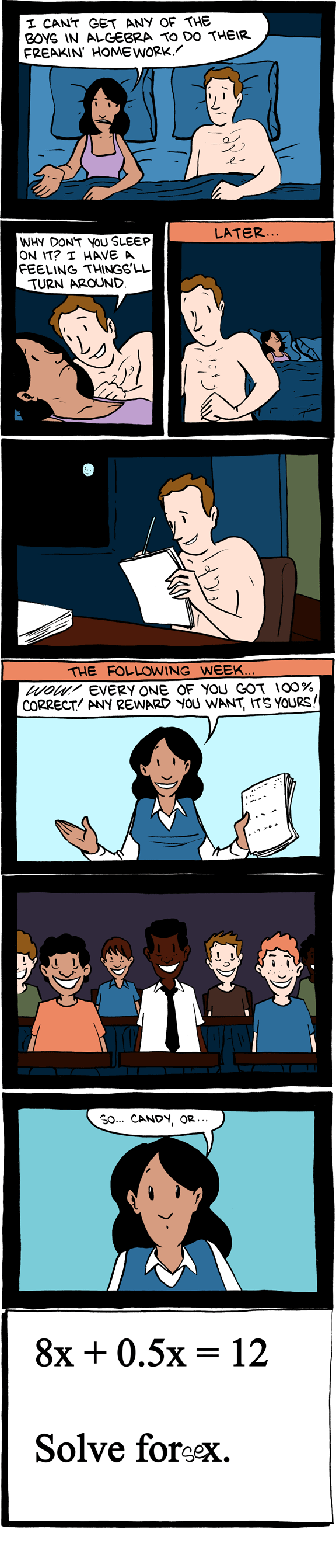
I love how Saturday Morning Breakfast Cereal captures science and education so well. I sometimes struggle to motivate some of my male students, so I paid special attention to this particular strip!


Now I have never propositioned any of my students (oh dear lord no!). I do recall, however, one day walking around my lab while students were working on past papers, and stopping in front of three young men to explain one of the questions. I leaned over the desk in front of them, propping myself up on one elbow. I explained the question, and looked up for some acknowledgement of understanding. And I saw all three of the boys looking at me in exactly the same way as shown above.

So the moral of the story is not to wear low-cut tops and lean over desks, I guess...

Friday, 24 June 2011

Things My Students Learned From Me

Last year (for some reason I didn't do any this year) I regaled you all with the things I learned from my students. It is now the end of term, or near enough - I don't expect to see the BTEC students in next week as they've all handed in their work, and in fact as this post is published I am sitting down to dinner with the class I've taught for two years and their tutor. The A2 students are all done bar those insane enough to do A-level physics, who have their final exam on Monday. And the AS students have had quite enough Intro to A2, and hopefully are defoliating trees to do the leaf margin analysis I set them as summer homework.

Occasionally I am reminded that my students learn things from me. Obviously one would hope that the key points of the syllabus are the major things they learn, but sometimes they say something that lets me know they were listening to an off-the-cuff remark or brief aside.

The word "misanthropic"

In an attempt to wear me down at the start of the year, whenever I asked a student of non-white heritage to move seats (I asked a lot of students to move - many of these were not white!), a couple of my absolute favourite students shouted out "Racist!". My response to this was "I'm not a racist, I'm a misanthropist - I hate everybody equally". The outcome of this was one of my A2s taking that word as a lifestyle choice, and Misanthropic Network was born (fortunately they haven't posted anything since April as they are all far too busy revising for exams). You should check it out - the "Walking With Humans" video is very funny.

Skinner boxes

One of the most enjoyable aspects of teaching GCSE biology last year was a brief section on animal behaviour, including classic and operant conditioning. The students, being bloodthirsty little boys and girls, really responded to the idea of electrocuting rats and pigeons, and thought it should be a central aspect of college discipline.

Skinner box scheme 01

Some of those students are now in my AS class, and if any of the others misbehave, or if I am trying to encourage attentive and responsive behaviour in class, one of my former GCSEs will pipe up "Get the Skinner box, miss!".

The true nature of pollen

When talking about plant anatomy to a load of students who really don't give a shit about anything that isn't human biology, it sometimes helps them if I make the connections between the organs and tissues. This means I really labour the point about flowers being plant genitals, for example.

It made my day when I heard a student sneeze in my class and then squeal "Stupid tree sperm!" - something embedded itself in her memory.

When to say "bastard" in polite company

Why, when you're referring to the bastard wing or alula, of course!


We have a swear jar. It's 10p for "shit", "fuck" or "cunt". If I drop an F-bomb I have to put in 20p as I'm a teacher and I should know better. The A2s have to put in £1 if they mention the word "germ" during the immunity topic. Some of the little darlings tried to get me to say "bastard" in an attempt to extract 20p from me for the swear jar, by retrieving one of the pigeon wings and asking me what the label said. They got part of their wish, for me to say "bastard", but they also got a long lecture on why it was called so and why that was not a swear word.

Cummingtonite


I rest my case.

It might be worth taking action against AGW

I scraped the surface of climate change on Tuesday with the Intro to A2 class. They saw the evidence, but were a little sceptical still. So I showed them this video:


Usually some of them zone out if I bung on a video, but they fixed on the screen and watched intently for the whole 10 minutes. They even said that it was a really good video. And then they said I'd ruined their summer for them and made them really depressed.

So I reminded them that there was still plenty that could be done and that they could go some way towards doing those things, and I bid them on their way for the summer.

Monday, 21 February 2011

Is That A Triceratops On Your Junk Or Are You Just Pleased To See Me?

A little light relief after all the deep academic navel-gazing, I think...

Thanks to my friend Owen, I am now aware of the existence of these swimming trunks:


Come on guys - buy these and wear them in the hot tub on the first night of SVP. It will make a change from the dino-themed ties and t-shirts.

I dare you.

Thursday, 2 December 2010

Things I Learned From My Students #9: Snow

The UK is currently the laughing stock of the best part of Europe and North America, as we've had some snow and ground to a halt. In fairness to us, snow like this is the sort of thing for which we're about as prepared as Toronto is for a plague of frogs, due to its rarity. On the other hand, you'd think if you got a plague of frogs three years running around about the time that plagues of frogs were most likely, that you might start planning for the increased chances of being plagued by frogs.

Anyway, London only just got the snow today, and it's not bad enough to close the college. So it was on with the hiking boots to brave the treacherous two-minute walk along the ungritted road to work. And on with a few more revelations.

  1. It takes a special sort of teacher to leave the windows open in the biology lab over the weekend, rendering the internal climate positively Siberian (this was NOT me).
  2. No matter how cold the students are, they are never cold enough to take you up on the offer to put a lab coat on as another layer.
  3. Edexcel doesn't think it's worth teaching students about competitive and non-competitive inhibition anymore.
  4. Despite nearly 30 years of public outreach and education on this matter, students still think that HIV came from people having sex with monkeys.
  5. None of them had ever heard of a dental dam.
  6. Yet one of them has a fleshlight called Mirabel.
  7. They think that Coxsackieviruses are the best thing ever.
  8. Until they hear about Cummingtonite, that is.
  9. People who named towns in New England were well kinky.
  10. You never want to spot a student googling for "reason for late period".
  11. The fake foam rock stress toy I got from Blackwell Scientific a few years ago as a promo gift is more realistic than I had ever realised...
  12. The little bugger who threw the snowball through the staffroom window (open 3") to hit my desk this morning should be automatically presented with an A* in mechanics as they have an absolute mastery of projectiles.
There's a very definite "inappropriate" theme to this one. I put it down to covering disease transmission in A2 biology, physiology of the endocrine system in BTEC and the presence of a large student union-run awareness campaign around World AIDS Day. It's just been condoms a-go-go all week.

Wednesday, 27 October 2010

DeskLab-Crops

It's time for this month's Accretionary Wedge, hosted by Matt at Research At A Snail's Pace. The theme is "Desk-crops" - not only are we encouraged to submit the spookiest images we can find, but there's a nice broad definition of "geological" to give me some lee-way.

What spookier way to celebrate Hallowe'en than to take you into the little shop of horrors that is my biology teaching lab? First up is my comparative anatomy collection:


Paul and I painted them up using acrylics over the summer, having been inspired by the fantastic comparative anatomy collection at the Mammoth Site. Just the right half is painted, allowing students to examine the original bones.

Also of note is the wet collection. We have amazing stuff, representative of all the animal phyla and plant divisions. I've been able to use the samples for teaching classification:


Please don't shout at me for using the word "starfish" - this was a distinctly basic science class full of students who think that nothing without a backbone is a "real" animal... Gruesome specimens also include the medicinal leech, the skate (used to investigate whether the cloaca of a manta ray really was likely to be similar in dimensions to the human vagina - a classic A2 biology moment!) and the pregnant rat complete with a dozen foetuses! The jar of lizards has also been used to rescue short-notice cover lessons and as a threat against non-science students messing around outside the lab.

It's not a bad lab - nice and big and plenty of space. Unfortunately it won't last - we are moving to a new building next year and the biology lab space will be halved. I'm going to make sure the specimens come with us, and the lab technicians are in agreement.


The most chilling specimen of all, however, is lying on top of the cabinets. The staff are divided over its usefulness and the appropriateness of keeping it. It's a real human skeleton. The older students are fascinated, but thinking it's a little undignified for the former owner of the skeleton. To this I say it's a bit more dignified than being shoved in a box and stored under the lab sink, which is where the other two bodies are.

And then the discussion starts up about whether using a skeletal human hand as a masturbatory aid counts as necrophilia, and it's clear the biology lesson is over... Happy Hallowe'en everyone - don't have nightmares.

Sunday, 16 May 2010

Things I Learned From My Students #5: Pre-Exams Edition

The kids are starting to get scared about the exams. This is probably A Good Thing given that the GCSEs start this Friday. So here are some more nuggets of wisdom gleaned from the pre-exam scramble.

  1. There is a mythical goal called "Finishing The Syllabus" that few if any teachers attain comfortably.
  2. Even if you do manage to finish your syllabus the exam board will find a way to screw you over by putting the last module you covered first in the timetable so the poor kids have barely any time to revise it.
  3. Students aren't very good at spotting trends, and will predict the next in the sequence A A A A A A A A A as D.
  4. There will come a time when students just kind of give up on doing homework.
  5. There will come a time when said students just start laughing when you mention the idea of homework.
  6. Despite doing a Spearman's Rank Correlation on the grades acquired by the students versus the number of pieces of homework submitted, you will find no link and be forced to concede defeat.
  7. I'm one of those teachers who has vowed never to let a student down or to be the limiting factor in their progression.
  8. This means I'm spending a lot of time being let down by students.
  9. We really really need to keep our comparative anatomy collection.
  10. I'm getting a reputation as "that teacher who carries around animal skulls all the time".
  11. I like that reputation.
  12. Every class thinks they're the worst class I teach. Except the class that is actually the worst.
  13. Using the Venganza pirates-versus-temperature correlation graph to make a point can result in a fascinating conversation with some Somali lads who are very proud of their nation's long tradition of piracy.
  14. No student ever gets tired of watching birds of paradise doing their mating dances.
  15. Your responsibilities are far from over when they've finished the course and left college.
I doubt any of my kids read the blog, but if they are, here is a message for them:
You know more than you think you do. You are capable of everything you set your heart on. Read the goddamn question before you answer it.
Good luck kiddlywinks!

Sunday, 11 April 2010

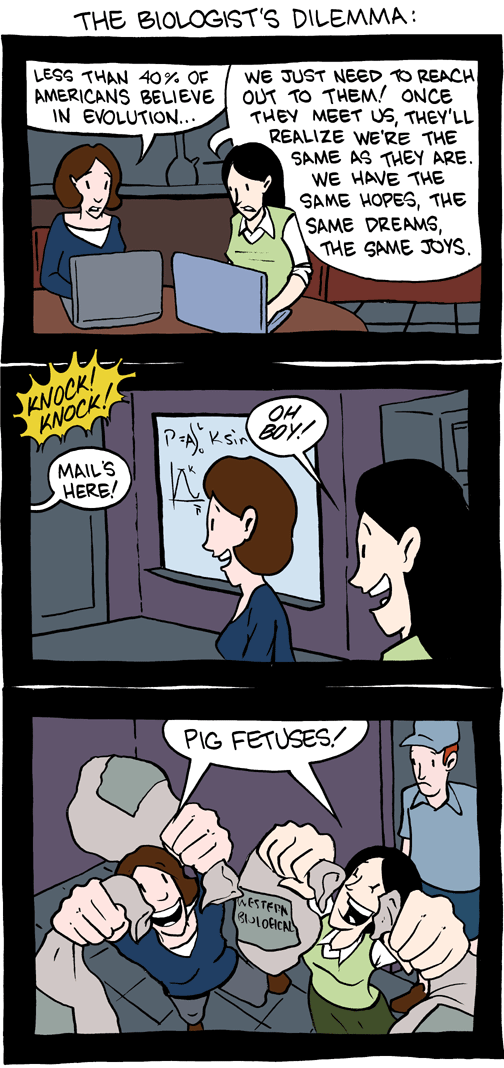
The Biologist's Dilemma

During the last week of term, I ordered a dozen sheep hearts for the A2 students to dissect. It is my greatest hope that some of my students become biologists like these two:

Sunday, 7 February 2010

Things I Learned From My Students #3: Special Pre-Grading Edition

It's time for official grading and internal inspections. Which means I'm getting assessed on the quality of my teaching. Eeeeek!! So here's a mid-term edition of TILFMS:
  1. Once you use a "That's what she said" joke in front of your adult students, they will sprinkle each biology class with a liberal serving of the same joke.
  2. You will actually find that even the topic of tropisms in plants can be made more interesting with a "That's what she said" response from a student.
  3. Even grown-up students like to do silly experiments growing broad beans in glass beakers.
  4. Nothing gets a kid interested in chemistry quite like turning a liquid phenolphthalein pink.
  5. Students sometimes need to dress up in a lab coat and goggles to feel like real scientists.
  6. PowerPoint can be used to make multiple choice quizzes and it looks amazing!
  7. The word "pussy" is rude and must be asterisked to "pu***", yet "dick", "tits" and "ass" are all perfectly acceptable labels for diagrams showing male and femal sexual characteristics.
  8. The poor darlings have never heard of the word "vulva", but have heard of a Volvo.
  9. Sometimes a badly-behaved class is much more fun to teach than a well-behaved quiet group.
  10. Having a student assert that the male cancer cell she is examining under a microscope is from "ballsack cancer" doesn't actually affect how an observer thinks the lesson went.
  11. Students who speak English as a second language really like simple, clean jokes, e.g. "What do you call a fish with no eyes?" "A fsh." It helps that they were learning about follicle-stimulating hormone at the time.
  12. The increase in admin and paperwork sometimes makes the job less fun, but the contact time with those kids balances it out and then some.
  13. Mimosa pudica plants are amazing.
  14. If you avoid scrolling down to the comments, YouTube has a phenomenal range of teaching resources.
  15. Some of my students have incredible talents in non-scientific areas such as art and music, and I really must make use of this in class.

Saturday, 19 December 2009

Things I Learned From My Students #2: Christmas 2009

Don't ask me how, but I survived the first term of teaching. And I managed to make enough of an impression to be asked to coordinate a new Level 1 (pre-GCSE) science course next term. I'll be branching out from Biology to teach general science (scientific units, method, how to draw apparatus etc) and a bit of Physics (space travel!), which I will thoroughly enjoy! Anyway, on with this half term's things I learned...
  1. Teenage boys are very often much better behaved than teenage girls.
  2. Not only does the word "dinosaur" have numerous different spellings, but my own name does too.
  3. There are some young people who have never heard of LOLcats.
  4. Younger students can easily be controlled by pointing to the lab skeleton and commenting that it was all that was left of the last student to answer me back.
  5. Hermaphrodites are the most fascinating subject ever.
  6. This is closely followed by brains.
  7. The precipitation on the day of the quadrat-throwing fieldwork is inversely proportional to the uptake of students for A-Level Biology.
  8. Some students know the most amazing facts, such as the ins and outs of the Battle of Thermopylae and the evolutionary history of the coelacanth (same student)!
  9. Kids of any age love playing "hangman" with new words.
  10. Dance music sounds just as dire in Korean as it does in English.
  11. Seeing my students get interviews and offers at universities fills me with more pride than I ever knew I was capable of.
  12. All the scientific literacy I embed in their brains will not stop them from genuinely believing the world will end in 2012.
  13. Apparently I get locked in the prep room overnight and at weekends.
  14. I am the only Biology lecturer who can identify blowflies.
  15. No teacher can compete with snow falling outside the lab window.
  16. It's probably just best if I don't tell the kids what is in haggis.

Monday, 26 October 2009

Things I Learned From My Students #1: Autumn 2009

  1. It's really uncool and old-fashioned to call it a "pen-drive" rather than a "USB".
  2. No one born after 1991 has ever heard of "2001: A Space Odyssey".
  3. Arsene Wenger speaks nine different languages.
  4. There's a lot of really complicated stuff going on in "Eastenders" at the moment.
  5. Deep questions like "How do snails have sex?" are really fascinating.
  6. Everyone likes to look at bones and formaldehyde specimens, and even the dullest class can be rescued with "Who wants to play with a skeleton?".
  7. The word "dinosaurs" can be spelt in a gazillion different ways, none of which are the correct ones: dinosours, danosouer, dinisours, dinosauras, dinosuars, dinosaurus, dinasours, dinosauris, dinosourse.
  8. Charles Darwin looks an awful lot like Santa Claus.
  9. The CSI Effect should never be underestimated.
  10. A student who says they can get hold of some human hearts for next term's dissection class should be given a wide berth after dark.
  11. Robert Pattinson is apparently a hunk.
  12. A lack of forward planning on the students' part ALWAYS constitutes an emergency on my part.
  13. Something will happen every day to surprise you. Sometimes it will be a good surprise. Sometimes it won't...
  14. Every teenager has a Hotmail address that they're really going to regret when they go to university.
  15. The age of 29 is considered positively Jurassic (or at least it would be if any of them knew what Jurassic meant).
  16. You will learn more about your student at parents' evening than you will ever find out from them in class.

Thursday, 13 August 2009

Happy Left-Handers Day, Fellow Southpaws!

Today, 13th August, is a cool day for me. It's my "half-birthday", meaning I am now just six short months from the big 3-0. It is also International Left-Handers Day, where (if you choose to celebrate) the 10% of us who have to exist in a right-handed world can turn the tables and designate a "Lefty Zone" (don't worry Paul, given this morning's smoothie incident you have enough trouble coping with ambidextrous and right-handed equipment, let alone stuff designed for a lefty, so consider yourself spared!).

So here's a list of everyday equipment that I have to struggle to use, use with my non-dominant hand or try to find a left-handed version:
  • Pens (we need quick-drying ink or a pen that will adapt to the different way a lefty has to hold a pen to see what they've written, and the nib has to be able to cope with a lefty pushing rather than pulling the pen across the page - biros saved our lives!)
  • Rulers (I have a left-handed ruler now, where the "0" is on the right hand side)
  • Scissors (using a right-handed pair makes it very difficult to see the line that needs to be cut)
  • Cake forks (never any point in giving me a righty cake fork because I won't use the "blade")
  • Kettles (the level indicator is almost always set up so the handle is on the right hand side - I've adapted to using it right-handed)
  • Computer mice (once upon a time there wasn't an option to swap over the buttons, or spend ages in computing classes switching the mouse to the other side of the keyboard so I learned to use it right-handed)
  • Microwaves (all the buttons are on the right hand side)
  • Can openers (thank goodness most of the plastic ones out now are ambidextrous)
  • Ticket barriers (I still have a fumble at the ticket barriers as I remember to swap hands or cross my left arm over my body)
  • Hockey sticks (despite an average of three lefty students per class my school had no lefty hockey sticks, so I played with a right-handed one and sucked badly at hockey)
  • Computer keyboard (the sodding number keys are always on the right hand side, making fast data entry difficult for the lefty)
However, while these things are an annoyance (and probably much more so for people who cannot use their right hand for anything - I'm at least moderately ambidextrous with some things), I wouldn't be so foolish as to expect massive design changes in things like ticket barriers and microwaves. I'm sure if it bothered me enough I could get a left-handed keyboard, and stationery and kitchen equipment is well catered for at Anything Left-Handed.

A couple of years ago I mentioned research on the LRRTM1 gene, which may go some way to explaining why three members of my family were or are left-handed (out of 10 of my grandfather's descendants plus himself). It'll be interesting to see which hand Grandpa's great-grandchildren and great-great-grandchildren use, and whether the world will be a little less frustrating for them to live in.
Related Posts Plugin for WordPress, Blogger...