Saturday, 19 May 2012

Lab Animals

I've had plants in my biology lab for a couple of years now - the bog-standard variegated Pelargonium, a couple of parrot plants, some cycads too fragile for my garden and a Sarracenia that uses more distilled water than all the week's practicals put together.

But it's clear that all labs need some animal life (in addition to the students), whether it's hamsters, fish or something a bit more exotic. Dave had suggested Mexican blind cave fish, which were a really interesting species. I'd been interested in cichlids, so I could point at them and shout "SYMPATRIC SPECIATION! LOOK!!!" at incredulous A2 students. But tropical fish would have been very high-maintenance - too much for a lab that would be shut down entirely for ten days at Christmas, even if I could have come in to feed and clean the fish during the holidays.

Then, one dismal Sunday afternoon a few weeks ago, I went to the Isleworth Spring Fair, to support Paul, who was working on a stall. We had a bit of a wander round on one of his breaks, and saw a tent with a bit of activity going on. As soon as I walked in I saw there were lots of animals there to be handled! I chatted to the owner of the animals - he works for the education department at the Natural History Museum normally, but evidently has a bit of a side project bringing his pets to events for people to learn about. He had a python, corn snake, milk snake, veiled chameleon, bearded dragon and loads of invertebrates.

Including a giant millipede.

Turns out these guys are really low-maintenance and fascinating creatures. It's a bit like being walked on by a toothbrush. They are herbivorous, and detritivores at that, so the freshness of the food is not really an issue. They have a commensal relationship with cleaner mites, and their anatomy is really interesting.


They arrived by courier on Wednesday evening and I brought them straight into the lab. The first one I put in the tank was absolutely enormous, bold as brass and very curious. It investigated the tank thoroughly, then positively inhaled a slice of leek. The second one was grumpy, curled itself up in a ball and sulked for hours. I'm astounded that it didn't cover me in cyanide, it was so pissed off with me. They are both pooing like it's going out of fashion too.

For reasons that will only be clear to my A2 students, the first one has been named Bodman (left in both pictures), and the second one Moisted.


Two of my students have held them so far. One of the BTEC girls asked to hold it and then got scared when its legs started to move. And I made my prospective vet student hold one and told him he'd better get used to them as he might have some as patients.

With my AS students in the middle of exams, and my A2s about to start, and my BTECs starting to wind down and finish their assignments, it's nice to have something still alive in the lab to nurture, sustain and care for. It might make the end of term seem a little less wretched than it usually does.

Thursday, 10 May 2012

Rule 34

Someone who doesn't know me might be forgiven for thinking that, as a member of the teaching profession, I am somehow morally righteous, prudish and humourless in the classroom. The rest of you will be under no such assumptions. The following video is a fairly typical exchange between students and eventually me - this week I introduced them to Rule 34.

Other than the information that this is my A2 Biology class, who were doing their final core practical ("Investigating Habituation to a Stimulus"), the students are anonymised. Members of the class who happen upon this video will instantly know who the students are, but I was sure not to film their faces, and no one refers to anyone by name, so their dignity (such as it is) is preserved. All the students in the video, whether in shot or in voice only, are over 18.

Which makes the way they are about to respond to the snail utterly hilarious.


Tomorrow I finish the A2 syllabus, and then it's past papers and practice questions until the exams begin. I really am going to miss this group - a few I have only taught for one academic year, but most of them have been my students for two years. A select handful were my first GCSE class nearly three years ago. In that regard it's the end of an era.

They have made me laugh and cry, sometimes in equal measure. They have frustrated and delighted. Their utter revulsion at the thought of doing fieldwork was one of my most challenging A2 moments, but the weeks we've spent on their coursework have been as strong a bonding experience all round as yomping around a field would have been. They have offers at a range of universities to study great things. As I do each year, I will be very tearful at the end of their Unit 5 exam, and the lab will feel a lot quieter for a while.

They are going to save the world, and it has been a privilege to teach them. Even if they are a load of big girls' blouses when it comes to poking a snail or two.

Wednesday, 25 April 2012

Cauli-Flowers

In January, I attended the ASE Annual Conference in Liverpool. Among all the many amazing demonstrations, talks, workshops and exhibits, I got chatting to some of the representatives from SAPS, who were showing off a new protocol for plant totipotency experiments.

For those readers for whom organisms have to have been dead for a few million years before they're worth studying, totipotency refers to the ability of plant cells to differentiate into any other cell in the plant. Our cells lose that ability a few days after fertilisation, but the few that remain are referred to as stem cells. So basically all plant cells are stem cells if you like.

Last year, we did the standard Edexcel protocol of decapitating mustard explants and growing them in agar. Despite relatively good hygiene, this was mostly an exercise in just how filthy my AS students were - you should have seen what grew in the agar, and none of the growing things were mustard explants. Little grey worm things, anyone?

Being not overly optimistic about this year's students' personal hygiene, I was keen to try out an alternative route, and SAPS had a good protocol. It's so elegantly simple. Plain agar is used rather than nutrient agar, and it's made up using Milton tablets. A fresh cauliflower should be used, but the tiniest bits can be used, so with the leftovers the technicians can have cauliflower cheese for their lunch.

About three weeks before the Easter holidays, my AS groups did the plant totipotency practical. Just before the Easter holiday it was clear the experiment had worked, as bits were turning photosynthetic, but we decided to keep the experiment running for as long as possible.


All this came out of a couple of tiny little florets, no more than 3-4mm wide. There are some proper leaves, up at the top of the plant. But this one was really impressive:


Can you see a purple patch over on the right hand side? That is a cauliflower flower!

I am so delighted with this practical - I think of all the AS and A2 ones I've done this year, this has been my favourite. Some students' cauliflowers did not take to differentiating - for some students there was a pretty obvious explanation (they suspended it halfway down the agar column, completely suffocating it but preserving it beautifully), but others just went a little brown and sat there. I had about a dozen vials across both groups, and four of them worked superbly, which is a better success rate than the old root tip squash (another old faithful A-level practical).

I'm very grateful to SAPS for their advice - they were really helpful when we were having difficulties tracking down plain agar, and they even e-mailed me when they saw me chatting on Twitter to another teacher about the protocol.

Now I'm just going to see how long we can keep these little baby cauliflowers growing...

Monday, 23 April 2012

Ave Praeceptor! Morituri Te Salutant

In just under three weeks' time I shall be sending my little AS Biology lambs off to the slaughter. Or the Unit 1 exam, as I think they prefer to call it. I haven't taught them everything I know, because then they'd have total recall of the Eagles' back catalogue and they'd never drink Southern Comfort. But I've taught them a massive amount. And the survivors get to come back and do another year of it before starting university.

My father continues to be impressed that I've got as far as finishing the syllabus (apparently this was something of an aspirational target rather than something expected of teachers when he was in the business). That said, I haven't told him that I'm frankly shitting myself over whether I'll finish the A2 syllabus in time to give those poor buggers sufficient time to revise.


I'm feeding my AS and A2 students bits of exam technique as I go along. Last week I gave one of the classes the news article claiming that "Drinking water improves exam grades", and they examined the claims before reaching their own conclusions on the quality of the study and how they would eliminate some of the rather obvious flaws (e.g. whether bringing a water bottle and drinking from it was a proxy for overall preparedness).

Of course, then I had to tell them that Omega-3 and Brain Gym are a load of old codswallop, and that it really was a little too late to be looking for short-cut ways to improve "brain power". But then again, no one ever got a marketing deal out of "Eat a healthy balanced diet, do a bit of exercise and work your bloody socks off". I ate marmite on wholemeal toast for breakfast for a month before my finals at Cambridge, and I don't imagine it did me any more good than if I'd had a bacon sandwich from Nadia's Patisserie.

Any useful tips I can pass on to my students other than RTFQ and ATFQ?

Friday, 30 March 2012

Hexagonal Learning

The spring term ended today, and unlike the end of the autumn term, where I may have slightly gone down the pub a bit, I came straight home to unwind. And yet, here I am, blogging about an awesome teaching moment today.

For a while I've been playing around with SOLO Taxonomy as an aid to learning. I'm trying it out with my AS Biology workshop, a one-hour class for extra support across both AS groups. They use sheets as devised by Tait Coles to get to grips with the hierarchy and identify targets for themselves. My main aim was to get them beyond multistructural thinking and into relational thinking.

For the final workshop of the term this morning, I decided to try the Hexagons. Some of the students were still struggling to consolidate their learning, so I asked them to pick the topic they were struggling with most. One group managed a little, and were able to put key events of mitosis into a sequence (though I may have pared down some of their text a bit):


Where it really worked, however, was with a small group of my high-fliers. They started off looking at cell membranes:


But it kept growing and growing. Periodically I came over, wrote another key term on a hexagon and threw it in to stretch them. By the end of the lesson it looked like this:


They had linked it through to protein synthesis, protein transport and the cell cycle, and at one point when they linked both CFTR and protein synthesis through to genetics I wondered if I should have got them to stick the hexagons on a ball to make all the links! They were thinking about where to put the hexagons and make the links, and one girl said she hadn't realised all the topics were so interlinked.

The next stage of this is for them to think about the nodes between the hexagons. They're showing relational thinking, but I need to get them to extended abstract if they are going to get the top grades at AS and A2. I should probably have tried to get them onto that today, but they were so enthusiastic that I wanted to let them continue for the full session!

Tuesday, 20 March 2012

The Hugging Minefield

A heartbreaking end to the working day today. I was sitting in my lab marking some mock exam papers. One of my students appeared and asked if we could talk. And then this tall, confident young man just broke down in tears. Events of the past few weeks, months, years even, caught up with him. Poor lad is terrified of not getting the grades he needs, and he's got an awful lot of mitigating circumstances affecting his chances of achieving this. I grabbed a handful of paper towels in the absence of tissues, and he clung to them for dear life as we spoke. We went over what it was getting to him in terms of workload, how he was feeling, whether he was anxious or depressed, and what action he felt able to take at this stage.

On balance, he was in a better state when we concluded than he was when he came in. He knows he can come back and talk to me. But above all that, he probably needed a hug. I really felt he did. But I didn't think I could. Why? Well, we have guidelines telling us to avoid unnecessary contact with students. I'm normally quite a touchy-feely person. I do hug and kiss my friends when I see them. A hand on the shoulder, a high-five, a fist bump, all feature in my normal friendly repertoire. But I've toned it right down for dealing with students.

If I am seen giving a student, especially a male student, a hug, then that would certainly start a rumour mill going - some of my colleagues have raised eyebrows at my close working relationships with male students (though it is usually because the male teachers have a tendency to be really hard on the male students, oddly enough), and I can do without a lot of gossip about me. Some of my female students have put an arm round me, and one of my BTEC boys decided he would grab my hand and kiss it directly underneath one of the CCTV cameras (doh!), but reciprocation is definitely frowned upon.

Finally, I am aware that I've got a rather insecure (though adult, he was definitely in a vulnerable emotional state) student pouring out his heart to me; I don't want him to think that our relationship is anything more than teacher/mentor and student. Students can become infatuated with their teachers, and though I don't think I'm much of a TILF, I've overheard students talking about the hotness of the most surprising colleagues. Positions of authority appear to be quite an aphrodisiac *boak*.

It was much more straightforward when my poor husband came into the lab half an hour later and also burst into tears. That I could deal with. Teaching is hard work. He had his awful class today. They stole his favourite pen. There is nothing in the guidelines that says I can't hug my own husband at work, and frankly if he thinks I'm a TILF then that's all good...

How do you lot approach comforting students? I imagine for the under-16s it's a no-brainer - no contact at all. But how do you comfort sixth-formers and adult learners? Is it still such a no-brainer? I wonder if it will be easier for me to dish out hugs when I get older. A colleague in her 50s had no qualms about hugging any and every student, but she was by that point easily old enough to be their mother - I'm still just about young enough to be a cougarish girlfriend.

Tuesday, 13 March 2012

Practical Instructions

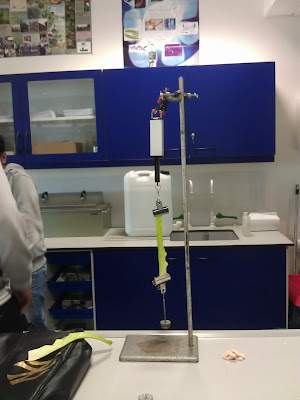
One of the Edexcel Unit 2 core practicals is the extraction of fibres from plants and the testing of their tensile strength. Students who have already done one of the AS physics practicals on Hooke's law should have had no trouble designing their own practicals, and I made sure there were physics students on each table to assist.

However, it occurred to me that the problem was not with biologists who didn't know physics, but with physicists who didn't know biology...


Why yes, that would be an entire stick of celery wedged between the bulldog clips. Extracting celery fibres. UR DOIN IT RONG.

Friday, 9 March 2012

Dear Students

Dear students,

This week has been one of those shitters, as far as weeks go. So this evening I've got myself a very large margarita (which you know is my favourite), and I'm toasting you as I go.


So this is for you and what we've all been through this week together:
  • For the A2 students who managed to do better in their biology results than in any other subject. You have shown a damn good understanding of the subject I love, and crucially given me bragging rights in the staffroom.
  • For C, who pleaded and pleaded for me to improve my predicted grade for him, and who said he would prove me wrong and perform better, well done. I am so proud of you, and I'll take spite as a motivator!
  • For A, who surprised everyone with an A grade, that was amazing - now do it again.
  • For F, who saw her results and hugged me, that meant a lot.
  • For the gang of boys I call the Women's Institute, your light sabre fight with the 1m rulers was fun this morning. Thank you for taking it in good humour when I implied there was a more Freudian explanation for your obsession with the big long sticks.
  • For my L2 group, thank you for only thinking to squirt the bottle of water at my computer screen, and not the big bottle of fake blood. That means a lot.
  • For S, who confessed she was responsible for this page because she felt I was an inspiring role model, you don't know how good that felt.
  • For K, who bounded into his genetics class on Monday to say he had an offer from University of Bedfordshire for biology, that is brilliant news!
  • For T, who has gone up against management, fighting for his rights and the rights of the other students, I am so proud of you. Some of the things that have been said to you today reminded me of another vindictive personality who made me cry hot tears of rage too.
  • For my amazing technician, who can keep his head when all about him are losing theirs (including me!), thank you for your patience and ability to pull practicals back from the brink.
  • For the ladies in the canteen who are so understanding when I run in, buy three cans of diet Coke and two Creme Eggs, you brighten up my day when I can feel the panic rising.
  • And for my husband, who has taken this week, only seeing me for a couple of hours at the start and end of the day, in his stride, and who, being a teacher too, just gets what it's like, and why I am doing this.
Cheers.

Tuesday, 28 February 2012

Two Things

In Friday's Grauniad, Oliver Burkeman was asking what the two things were to know in each subject. I thought this was a useful exercise, and might set it to my students as homework. What are the two main things to know about biology?

I'd be tempted to go with the following, borrowed from Theodosius Dobzhansky and Michael Lynch:

"Nothing in biology makes sense except in the light of evolution."

And:

"Nothing in evolution makes sense except in the light of population genetics."

My students haven't really done population genetics (the A2s have done a bit, but they haven't really done it). So they might have less nuanced ideas about the "two things". Maybe to look at it in my own words I'd go for a slightly different approach.

Life is an exercise in reverse entropy.

And:

All living organisms evolve, though the rate may vary.

What do you think about these "two things"? Would you choose different ones about biology or life sciences, or indeed the earth sciences, since I have a very earth sciencey view of biology!

Monday, 27 February 2012

Pet Photoshoots

Full disclosure: In return for agreeing to review the experience on this blog, I received a free pet photo shoot. The reviews were run by FuelMyBlog.

There comes a time in every proud parent's life (and they don't have to be human babies) when it's time to record one's pride and joy for posterity. When the opportunity for a free pet photo shoot came up on FuelMyBlog I volunteered - it would be nice to have a photo of Jabba done professionally, and I was interested to see how he could be posed in case I wanted to try out a few tricks with my DSLR.

The company is Wish. They are part of a blossoming "experience" industry, and one of the things they offer is a pet photo shoot. At the time of writing its cost has been marked down to £15, usually £50. This includes a 7x5 photograph.

Upon receiving the voucher, I had to phone to activate it and make the booking. However, the main problem with this was that the phone number was only active between 9am and 5pm Monday to Friday. I usually work 8am to 7pm minimum, so it was always going to be nigh on impossible to phone them. In fact it was the Christmas holiday (having received the voucher in early November) before I was actually free to phone. And the most annoying thing was that there was no information they asked for that could not have been given online. I could have done this over the internet and been sent the details of the studio that way.

So it was the new year before the studio got in touch with me to arrange Jabba's close-up. The studio in question was The Click Studios in Richmond. Again, the same problem presented itself that I had to call during normal office hours on a Monday to Friday. But somehow they managed to get hold of me at ASE (!) and then after I had finished teaching one afternoon. Jabba's portrait was duly arranged for 4th February.

Despite me giving them my name on a number of occasions, they insisted on calling me Juliet. Eventually I stopped trying to correct them and answered to Juliet each time. When we arrived for the shoot, the studio was crowded - there were at least three full families in there, waiting either for viewing or for their own photo shoot, and so we stood. We at least didn't have to wait very long. Our photographer was absolutely wonderful. She was not a fan of reptiles, but despite her nervousness around him she was professional, talented, and talked to him in a soft soothing voice. The whole shoot took about 10 minutes, and then we were invited in for viewing.

I'm always a little nervous about viewings, having had a bad experience with an unrelated agency a few years ago. I expected to be given the hard sell and sent on a guilt trip. We had none of that - the man showing us the photos accepted that we were just looking for one good photo for the 7x5 image, and he helped us narrow it down to one good one.

Nearly two weeks later I missed a call from them to say the photo was in, we could collect it, but that we should phone them before we come in. I phoned back on the Saturday, but they didn't answer. They also didn't return my voicemail. So last Saturday I phoned in my Teacher Voice. They called back within half an hour and we collected Jabba's picture.

It's a gorgeous photo. The photographer did an excellent job and she is to be commended. However, the experience was less than stellar. Simply the inaccessibility of the companies outside normal office hours (even banks do a Saturday morning) has been enough to deter me from using their services again, coupled with messages from FuelMyBlog pushing me to update them. The cost, were it £50, was a little steep for the 10-minute photo shoot and the photo.

And they have yet to refund my £20 deposit! So I may be writing a complaint letter...

I may use the studio again if I was looking to book a family or couples portrait, but even so, some of the prices look steep. For example, though it was six years ago, I paid £850 for our wedding photographer, including 300 photos and an album. I understand that studios have premises to maintain and so on, but it seems like an awfully big mark-up.


Detail of Jabba's portrait, scanned in badly and used for evaluation purposes.

Picture's amazing though.
Related Posts Plugin for WordPress, Blogger...